
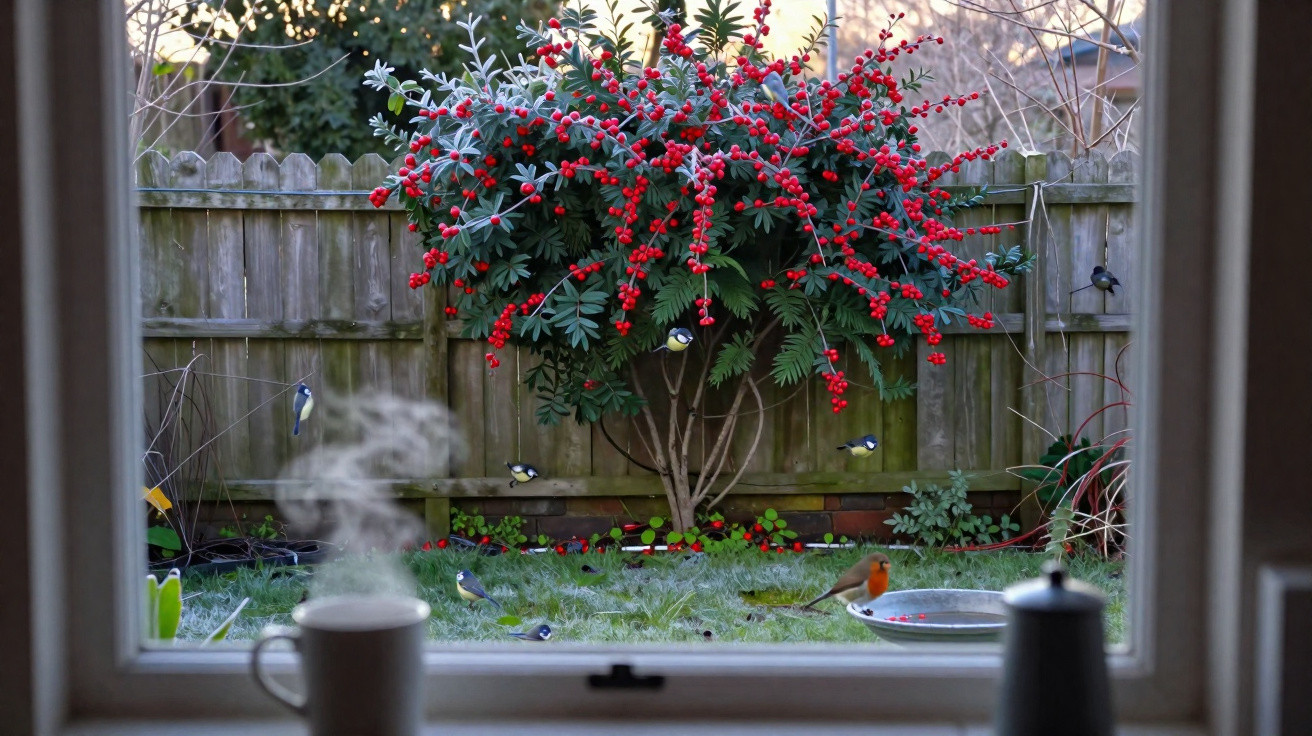
In December, an empty garden can read like a book you never opened. The feeder sits untouched, frost pins the grass down, and the only obvious motion is the cloud of your breath. But one shrub can change everything, bringing blue tits and robins into sharp focus when the rest of the scene seems dormant.
I found myself at the kitchen window, hands wrapped around a mug for warmth, in that slow kind of dawn where you listen for signs of life and also quietly wish it would show up. Suddenly two blue tits dropped into the thorny snarl along the fence, darting from spine to spine like quick notes on a stave. Beneath them, a robin bounced in and out of view, bold and bright, sizing up the red beads clustered across the branches.
They moved with a hushed urgency. This wasn’t a plant merely improving the view - it was offering food, cover, and a reason to stay. And it wasn’t the feeder doing the work.
The winter magnet hiding in plain sight: firethorn
Firethorn - the evergreen Pyracantha trained against a wall or allowed to bulk up into a hedge - is a winter spectacle many people overlook. Its stems are armed with spines, its leaves hold on through cold weather, and its berry clusters glow like small lanterns well into January. Robins treat those berries like pocket-sized treasure, hopping along to pluck and swallow them one by one. Blue tits rush in too, not so much for fruit as for what’s tucked into bark and twig: overwintering insects, spiders’ eggs, and larvae left behind.
What makes this plant unusual is that it offers both larder and refuge at once. Imagine a south-facing fence threaded with Pyracantha ‘Red Column’, the red fruit pressed tight against dark foliage. At 8 a.m., the sun reaches the wall and lifts the air temperature by a notch or two. The birds notice. They arrive in pulses, using the thorns as a framework and the shadow as protection, slipping between the spines with the kind of certainty that makes predators hesitate.
There’s a straightforward reason for the constant traffic. The berries ripen late and persist through the leanest part of the year - a built-in cold-store when little can be found on the ground. Those spines turn the shrub into a safe room, particularly for small birds that rely on quick hops and fast getaways. The dense interior also shelters overwintering insects, so even once the berries are finished there’s still protein on offer. Combine that with the warmth a wall holds from daytime sun and you get a small microclimate that keeps the garden quietly busy on bleak days.
Grow it right, and the birds write the rest
Begin with a young firethorn about knee-high and choose a position with morning sun and afternoons that don’t bake. Open up the soil, work in compost, and set the plant slightly proud so the crown isn’t buried. Fix horizontal wires along a fence or wall at 30–40 cm intervals, then spread the stems and tie them in with soft twine. The goal is a flat screen that fruits well. Water thoroughly after planting, then give a deep soak once a week during dry spells - you’re establishing roots now for winter visits later.
Pruning is the point where plenty of gardeners trip up. Cut back soon after flowering in late spring, when next winter’s berries are still a promise rather than a loss. Remove only what spoils your fan shape or grabs at the path. Avoid a heavy summer chop that can wipe out hundreds of berry clusters in minutes. Yes, the prickly one by the back fence. Wear gloves that offer some bite protection and keep stepping back so the shape stays gentle and airy.
Most of us have had the same realisation: you tidy the garden and only later see you’ve “cleared away” exactly what wildlife depended on. Keep sprays, harsh cleaning solutions, and over-enthusiastic tidying away from this shrub; the more lived-in it looks, the better the buffet. Birds aren’t searching for perfection - they want a dependable stop with calories and cover. Let’s be honest: no one manages this perfectly every day.
“A spiny evergreen with winter berries is a moving fortress for small birds,” says urban ecologist Anya Keating. “Pyracantha is especially valuable because it hosts insects and fruit at once. That double offer brings blue tits for the hunt and robins for the feast.”
- Quick win: combine firethorn with ivy or holly for layered shelter and a longer berry season.
- Timing tip: prune lightly right after flowering to protect next winter’s berry set.
- Wildlife boost: place a shallow dish of water nearby; winter birds drink more than you’d expect.
The quiet theatre outside your window
A shrub like this can transform winter mornings. You’ll pause halfway through pulling on a sock, watching a firethorn (Pyracantha) dip under a robin’s weight, or seeing a blue tit flash in and disappear again like a passing thought. The soundscape is subtle: faint peeps, dry scrapes through leaf litter, and the occasional tap of a thorny twig against glass as a branch nudges the shed. Small movements, big significance.
There’s a wider invitation in that kind of daily show. Plant one shrub that earns its keep in cold weather and see how the rest of the space shifts around it. Perhaps you add a log pile. Perhaps you set out a shallow tray that won’t freeze solid. Perhaps you simply notice more. The real point is that every winter needs a reason to look up, and this plant provides one - bright, stubborn, and delivered berry by berry.
| Key point | Detail | Why it matters to you |
|---|---|---|
| Pick the right shrub | Pyracantha trained on a wall or fence provides berries, cover, and insects | Brings winter berries within beak reach for robins and offers shelter for blue tits |
| Train, don’t tame | Wire supports and light pruning after flowering preserve fruiting wood and safe nooks | Maximises bird visits without high maintenance |
| Work with winter | Morning sun, nearby water, no chemicals, gentle edges | Creates a dependable, low-effort winter hotspot for wildlife |
FAQ:
- Which variety should I choose for berries and colour? Look for red or orange bearers like ‘Red Column’, ‘Saphyr Rouge’, or ‘Orange Charmer’. They fruit reliably and hold their colour deep into winter.
- Do blue tits actually eat the berries? They’ll occasionally take very small fruit, but they come mainly to hunt insects and eggs tucked into the shrub. The berries are a bigger draw for robins and thrush-sized birds.
- Is firethorn safe around kids and pets? The thorns are sharp, and the seeds inside the berries can cause mild stomach upset if eaten in quantity. Site it where little hands won’t grab, and sweep fallen berries near play areas.
- Can I grow it in a pot on a balcony? Yes, in a large container with a sturdy trellis and fresh, gritty compost. Expect slower growth and fewer berries than in the ground, but the shelter and insect life still help birds.
- How do I prune without losing next winter’s fruit? Trim right after flowering, keeping the fan shape and the short lateral spurs where berries form. Avoid a late-summer haircut that removes the developing clusters.
Comments
No comments yet. Be the first to comment!
Leave a Comment