
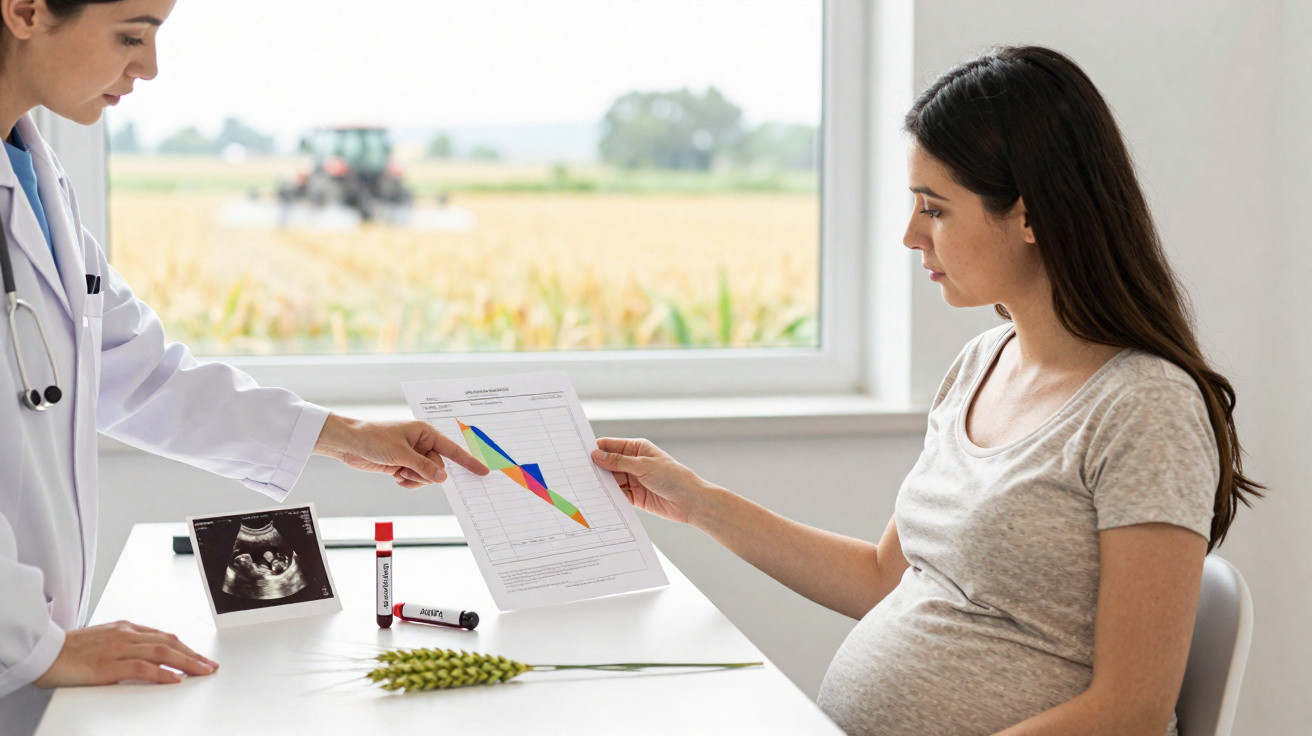
Spray, wait for it to dry, and for many householders that’s the end of the matter. The unspoken belief is that the weed killer stays outdoors - not that it might also end up inside the body of someone who is pregnant under the same roof.
To test that idea, researchers followed 752 pregnant women and repeatedly looked for a widely used herbicide in urine samples taken at several stages of pregnancy.
They also assessed the hormones that help sustain pregnancy. The associations they observed had not previously been shown in humans.
A chemical everywhere
Glyphosate is the most widely applied herbicide globally, used on farms and in front gardens, and it can make its way into food and drinking water.
More and more, scientists are examining it as a potential endocrine disruptor - a substance capable of interfering with the body’s hormonal systems.
In the environment, glyphosate degrades into AMPA, a more persistent compound that can remain in soil and water for longer.
Repeated studies across North America have detected one or both chemicals in human urine. That broad reach is what motivated the team behind this latest research.
John Meeker, a professor of environmental health sciences at the University of Michigan School of Public Health (U-M), led the study.
“This is the most extensively used herbicide in the world, yet there are shockingly few research studies on the potential impacts it may have on human reproductive health, pregnancy, or fetal and child development,” said Meeker.
So far, most evidence has come from animal experiments rather than studies in people.
What the team measured
Meeker and colleagues used data from an ongoing pregnancy study in Puerto Rico that has, for years, monitored environmental exposures alongside maternal health.
Their analysis included 752 pregnant women living in the island’s northern region.
Urine samples were collected up to three times during pregnancy, at approximately 18, 22, and 26 weeks.
At two of those appointments, blood was also taken to measure hormones that are important for keeping pregnancy progressing normally.
In most samples, researchers detected at least one of the two chemicals. These participants were not agricultural field workers.
Instead, exposure appeared to be part of everyday living, and the concentrations were somewhat higher than those typically reported in the general US population.
The oestrogen that dropped
The strongest and most consistent link involved oestriol, an oestrogen that rises throughout pregnancy and supports blood flow to the placenta as the fetus grows.
Higher levels of glyphosate and AMPA in urine tended to coincide with lower oestriol in the bloodstream.
With each step up in exposure, oestriol values were about 8 to 11 per cent lower. This pattern appeared at different sampling times and across multiple analytical approaches.
Before this research, no study had examined glyphosate in relation to this hormone in pregnant women.
The study does not establish why oestriol was lower. Laboratory findings suggest glyphosate could inhibit an enzyme involved in producing oestrogen, which would be consistent with the observed results.
However, the researchers documented the association rather than the biological pathway, so the underlying mechanism remains unresolved.
Thyroid and stress hormones
Changes were not limited to oestriol. AMPA was associated with higher thyroid hormone levels and, later in pregnancy, with a stronger signalling input from the brain to the thyroid.
Because thyroid hormones rise during pregnancy to support fetal growth, disruption in this system could have broader downstream effects.
Later in pregnancy, glyphosate was linked to increased levels of a stress hormone known as CRH.
CRH contributes to the timing of labour, and another study has connected the chemical with preterm birth.
From these data alone, it is not possible to determine whether the shifts began inside the thyroid gland itself or in the brain-driven signals that regulate it.
Fetal sex may influence the response
When the researchers analysed results by fetal sex, one pattern was particularly notable.
The relationship between higher exposure and lower oestriol looked stronger and more distinct among women carrying girls than among those carrying boys.
For thyroid-related measures, the pattern went in the opposite direction, appearing more clearly in pregnancies with a boy.
Neither pattern met the usual standard for statistical significance - they should be treated as trends rather than definitive findings.
Even so, the direction of the results fits a broader theme in endocrine research: developing boys and girls do not always react to the same chemical exposures in identical ways.
This adds to the case for routinely considering fetal sex in studies of hormonal disruption.
Where this could lead
The study’s contribution is a plausible biological link. Earlier work associated glyphosate exposure with reduced fetal growth and, in a separate publication, with differences in early childhood development.
What connected the chemical to those outcomes was uncertain. Disruption to hormone systems is now one possible explanation.
For clinicians and regulators, the discussion may now shift from a general concern to specific changes that can be measured.
A key next question is whether reduced oestriol or altered stress-hormone signalling helps explain the birth outcomes highlighted in earlier research.
The study cannot show that glyphosate caused the hormone changes, and urine samples reflect only relatively recent exposure.
Even so, it provides the first human evidence linking these chemicals to multiple hormone systems at the same time.
The team’s next step is to continue following the mothers and children.






Comments
No comments yet. Be the first to comment!
Leave a Comment