
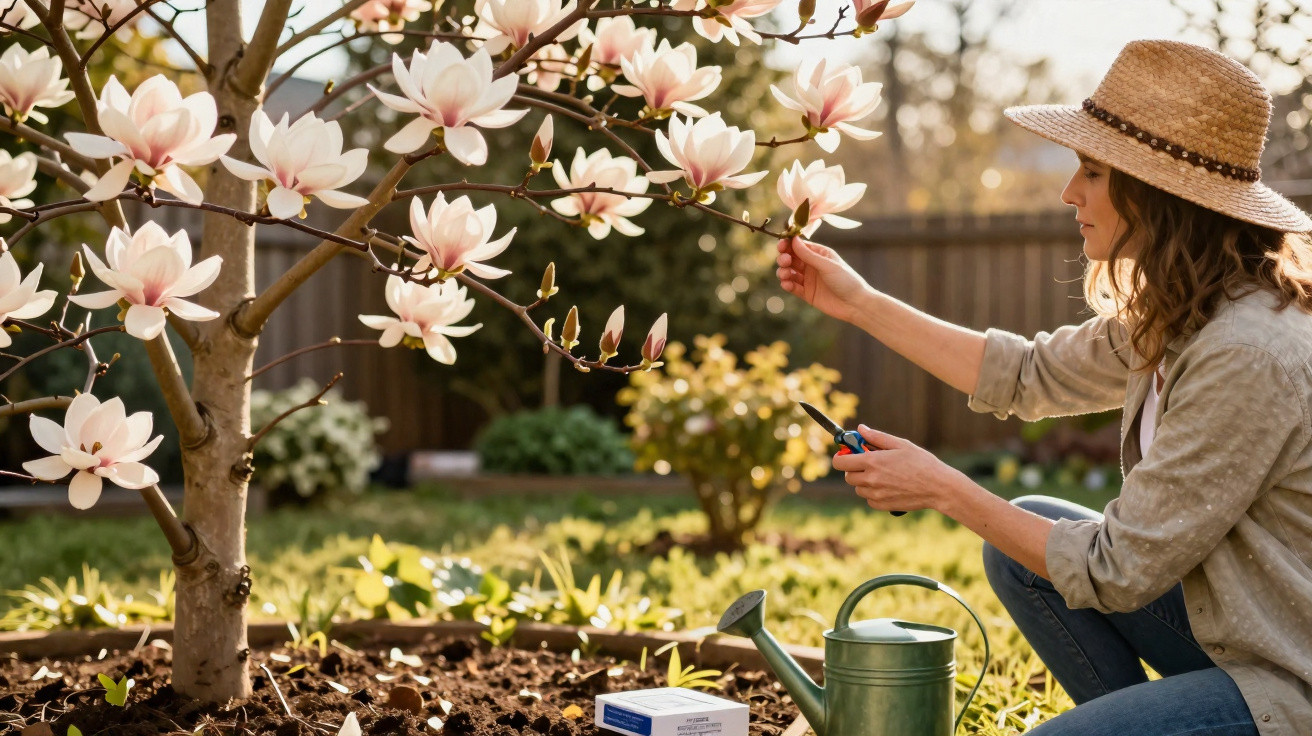
The morning air is still cool as you step out into the garden with a mug of coffee. Over the neighbour’s fence, a pink-and-white sea of cloud is glowing - their magnolia, year after year, like a small firework display. Yours, by comparison? A handful of scattered blooms, more dutiful than dazzling. You walk closer, run your fingers over the gnarled bark, and look for buds that never opened. Something feels off, and you can’t quite ignore it.
Most of us know that moment: the plants on the other side of the fence put on a show, while ours stay stubbornly quiet. You start wondering whether you’ve got something wrong - whether the soil is “bad”, or the tree is somehow offended. Then a quieter worry follows: could all that care actually have been too much? And the real question appears, hanging between bare twigs like a promise: why does your magnolia bloom so little?
When the magnolia falls silent: what steals your tree’s flowers
For much of summer, most magnolias look polite and unremarkable. Their real performance is meant to happen in spring - unless it doesn’t. When only a few flowers show up, the whole tree can suddenly look downcast, like an appearance that never quite happened. Usually it isn’t random; it’s more often the combined effect of location, weather and well‑intentioned meddling. A bit like asking a musician to shine on the wrong stage.
A pattern many gardeners recognise goes like this: in the first year after planting, the magnolia seems tentative. The second year brings a few more blooms, the third might deliver a little “wow” moment - and then one spring the stage is almost empty. In a small allotment garden in Cologne, an older woman once told me her magnolia produced hardly any flowers for almost six years after a radical prune. Neighbours assumed it must be “ill”. In reality, the tree had simply lost its flower buds - removed with the secateurs.
Magnolias form their flower buds well in advance, usually in the summer of the previous year. If you reach for the saw in autumn or winter with gusto, you are often cutting off exactly what you’re most looking forward to. Frost can do the same job: during a properly cold night in April, fat buds can freeze before they ever open. What you’re left with are a few sheltered flowers deep inside the crown - and the impression the tree “can’t be bothered” to bloom. The truth is far less personal: it’s just biology.
More flowers on your magnolia: what you can do in practice
The most effective first step is also the least exciting: leave it alone. No shaping, no “just making it a bit neater”. Magnolias aren’t box plants. If you absolutely have to prune, do it only straight after flowering, and do it lightly - a few cuts on younger shoots rather than major removals. That way, the flower buds formed over summer for next year remain largely untouched, and the tree isn’t constantly busy sealing wounds.
The second lever is underground, quiet and easy to miss. Magnolias prefer soil that is slightly acidic, open and crumbly - never bone‑dry, but also never compacted into something like concrete. Many sit for years in heavy, compressed clay, squeezed between lawn fertiliser and a well-worn path. A wide ring of leaf mould or bark mulch around the trunk can be close to therapeutic. Avoid digging right by the roots and don’t keep turning the soil: magnolia roots are shallow and can be touchy. Let’s be honest - hardly anyone loosens the ground perfectly every weekend with a fork.
If a magnolia carries plenty of leaves but only a few flowers, the cause is often too much nitrogen (for example, from lawn feed) alongside too little phosphorus or potassium. In that situation, the tree puts its energy into foliage rather than blooms. A modest, balanced feed in spring can help - ideally a fertiliser formulated for flowering shrubs, not “whatever’s left in the garage”.
“Most magnolias don’t fail because they aren’t loved enough - they fail because people do too much,” a tree surgeon once told me. “A good spot and a bit of peace and quiet often gets you halfway there.”
To judge your own tree more clearly, it helps to run through a simple internal checklist:
- Is the position bright enough, without full midday sun all day long?
- Was there a late frost in March/April that could have damaged the buds?
- Has the tree been heavily cut back in the last 12–18 months?
- What does the soil feel like: hard and compacted, or loose and humus‑rich?
- Is the lawn fertilised and mown right up to the trunk?
Between patience and control: what your magnolia is really telling you
Planting a magnolia is, in a way, inviting slowness into your garden. Many varieties take years before they reach dependable, full blossom. In an age of Prime delivery and instant results, that can feel almost cheeky. But there’s a quiet beauty in it: magnolias make us think in seasons rather than days. They’ll tolerate a fair bit - but they don’t enjoy hurry.
There are those hushed gardens where an old magnolia has stood for decades, barely pruned at all. The trunk may lean, the crown may be imperfect, yet every spring it seems to explode into flower. And then there are newly landscaped townhouse gardens where young magnolias are treated like decorative furniture: “shaped” every couple of years, planted in bagged soil, with lawn running right up to the trunk. Same label from the garden centre - completely different story in the ground. Plants are ruthless at reminding us that appearance is rarely the full truth.
When your magnolia flowers sparingly, it’s rarely a personal failure. More often it’s an invitation to look more closely: do less, but do it with intention. Watch out for frost. Feel the soil rather than only looking at it. And, in time, perhaps accept that this particular tree may never become an Instagram star - it might simply be a quiet companion each spring. Sometimes the value isn’t in 500 blooms, but in the five you actually notice.
| Key point | Detail | Benefit for the reader |
|---|---|---|
| Gentle pruning practice | Light thinning only straight after flowering; no radical cuts in autumn/winter | Protects the developing flower buds and prevents years‑long “flowering pauses” |
| Suitable site and soil | Bright position; slightly acidic, loose soil; mulched root area instead of hard lawn | Encourages bud formation and reduces stress from drought and compaction |
| Patience and restraint | Magnolias often take several years to flower reliably and react badly to over‑intervention | Reduces pressure, avoids misguided actions and improves understanding of the plant |
FAQ:
- Question 1 From what age does a magnolia “normally” flower richly?
- Question 2 Can I still transplant a magnolia that barely flowers?
- Question 3 Does a hard prune help to produce more flowers?
- Question 4 How can I tell whether frost has damaged my flower buds?
- Question 5 Should I fertilise my magnolia regularly if it flowers poorly?
Comments
No comments yet. Be the first to comment!
Leave a Comment