
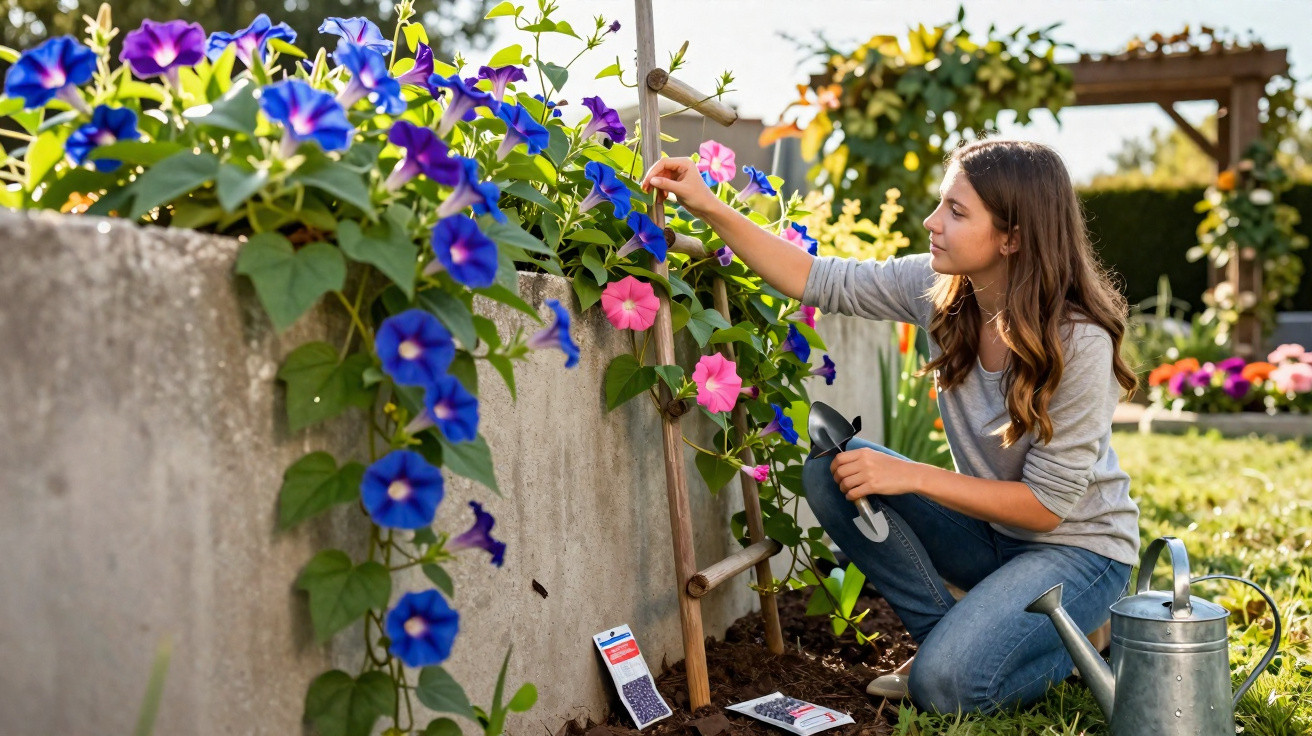
A drab garden wall, a dull grey fence, a concrete block in front of the patio - and within a few weeks it can look like a living green painting.
Plenty of amateur gardeners know the feeling: you’ve put real effort into the planting, but a bare wall or a metal fence ruins the whole atmosphere. Rather than waiting years for a hedge to thicken up, there’s a quick, affordable and surprisingly attractive fix: a climbing plant that can add several metres in just a few weeks and make gloomy surfaces virtually disappear.
The wall transformer: Ipomoea, also known as morning glory
Ipomoea (commonly called morning glory) belongs to the bindweed family. It’s an annual, it grows at speed, and it’s ideal for anyone who’s impatient - or simply fed up with staring at an ugly boundary.
Its heart-shaped leaves quickly form a dense curtain. The flowers open in the morning, close again later, and come in vivid colours such as blue, purple, pink or white. At the height of summer, a fully covered morning glory can feel like a living backdrop that shifts and changes day by day.
"With the right spot and a little care, morning glory can climb up to four metres in a few weeks and turn any problem wall into a colourful curtain of plants."
Why this particular climbing plant is so popular
Morning glory comes with several clear advantages:
- Dense, decorative foliage: heart-shaped leaves knit together into a solid green screen - ideal for hiding unattractive areas.
- Striking flowers: funnel-shaped blooms in many shades create an almost tropical feel in the garden.
- Turbo growth: in good conditions, it shoots up several metres in record time.
- Easy to look after: it copes even with poorer soil and doesn’t require complicated gardening know-how.
- Good for insects: the flowers attract bees, bumblebees and butterflies, bringing extra life into the garden.
The right timing: when to sow morning glory
The best window for sowing is in spring, once temperatures have properly softened and stayed mild. If you begin in March or April, you’re well placed for lush growth and flowers that get going early in summer. The soil shouldn’t still be icy cold, otherwise the seeds tend to germinate slowly.
If you leave it until late spring - or even into summer - the plant often won’t reach its full height before the season is over. So if you want that concrete wall out of sight as quickly as possible, get the seed in early; then the dreary view is often gone by June.
How to plant it successfully by a wall, fence or pergola
1. Position: lots of light, a bit of shelter
Morning glory thrives in sunshine. A south- or south-east-facing spot with long periods of light is particularly suitable. Light partial shade is possible, but flowering is usually less generous. Very exposed, windy corners are best avoided, as strong gusts can damage young shoots.
2. Prepare the soil
It doesn’t need anything fancy, but it does prefer soil that’s loose and free-draining. If the ground is compacted, lift it with a spade and work in some well-rotted compost. Waterlogging causes problems, so good drainage matters.
3. Sowing in simple steps
- Sow directly outdoors only after the last late frosts, usually from April or May.
- Soak the seeds in lukewarm water for about 12 hours beforehand to speed up germination.
- Sow around 1 cm deep, leaving roughly 30 cm between plants.
If you want to begin earlier, start plants in pots indoors or in a greenhouse, then move the young plants to their final position later. Try not to disturb the delicate roots.
4. Watering at the start
In the first few weeks after sowing, regular watering helps morning glory establish roots quickly. Once it’s properly settled in, it can cope with occasional dry spells. Too much wetness, however, can soon lead to plants that look limp and weaker.
5. It needs a support structure
Ipomoea twines upwards on its own, wrapping around anything it can grip: wire fencing, wooden trellis, a pergola, tensioned wires, bamboo canes. The key is to provide a sturdy support right from planting time. Loose wire or very thin canes can give way quickly in windy weather.
"If you give your morning glory a good climbing frame from day one, you’ll usually be rewarded with a continuous green wall after just a few weeks."
Summer care: keeping the green wall dense and full of flowers
Morning glory is one of the easier garden plants to manage, but a few habits make a noticeable difference.
- Water regularly, but don’t overdo it: during longer dry periods it needs a drink; afterwards, allow the soil to dry slightly again.
- Guide growth rather than letting it run wild: you can gently redirect or shorten individual shoots that get too long, helping the plant look fuller.
- Offer nutrients now and then: a little compost or diluted nettle feed supports both flowers and leafy growth without making the plant overly lush and soft.
- Remove spent blooms: regularly pinching off faded flowers encourages new buds.
Alternatives: other fast-growing climbers
If you don’t want to rely on a single species - or you’d like to treat different areas in different ways - morning glory can be paired with other rapid growers.
Virginia creeper for large façades
Virginia creeper is excellent for big surfaces such as house walls, garages or long boundary walls. It clings using small adhesive pads and generally doesn’t need extra support. In autumn, the foliage turns a bright red and orange, creating a dramatic display - especially on otherwise plain surfaces.
Evergreen clematis for shadier spots
An evergreen clematis, such as Armand clematis, keeps its leaves through winter and flowers with masses of white, scented, star-shaped blooms. It suits partially shaded positions where many other flowering plants struggle, and it gives darker walls an elegant, almost romantic look.
Golden hop as a bright focal point
Golden hop also grows quickly and can reach up to 5 m in a single season. Its yellow-green leaves create strong highlights, particularly against dark backgrounds or old wooden sheds. It looks a little wilder than the more delicate morning glory and suits naturalistic gardens perfectly.
| Climbing plant | Growth height per season | Special effect |
|---|---|---|
| Morning glory (Ipomoea) | up to about 4 m | Intensely coloured flowers, quickly hides walls |
| Virginia creeper | 3–5 m | Autumn colour, suits large façades |
| Evergreen clematis | 2–4 m | Scented flowers, keeps foliage in winter |
| Golden hop | up to about 5 m | Bright yellow foliage, more natural, wilder look |
What to consider before planting
If you live in rented accommodation with a balcony, or you share a small townhouse garden, it’s wise to agree things with your landlord or the building’s management company before greening entire façades. Climbers can hide cracks in masonry or grow into gutters if they’re left completely unattended. Keeping an eye on growth regularly helps prevent that sort of issue.
One more thing: morning glory produces plenty of seed. If you leave everything in place, it may reappear elsewhere the following year. Some gardeners enjoy this; if you prefer things tidy, collect the seeds deliberately and sow only where you genuinely want that green screen.
Practical combinations and design ideas
It gets particularly interesting when you mix different climbers. One approach: morning glory in bold colours at the bottom, with occasional golden hop for lighter accents, and a clematis with pale flowers in a shadier corner. That way, you create lively, layered “wall pictures” rather than one uniform sheet of green.
If you’d rather keep it understated, choose a single variety in a calmer shade - for instance, blue morning glory against a white-painted garage. In small gardens, even a narrow trellis with Ipomoea can be enough to screen the patio from prying eyes and create a more sheltered feel.
The reality is that a wall doesn’t need to be knocked down or replastered to stop it being an eyesore. A handful of seeds, a sunny spot and a simple support frame are often all it takes to turn a grey problem area into a lively feature in remarkably little time.
Comments
No comments yet. Be the first to comment!
Leave a Comment