
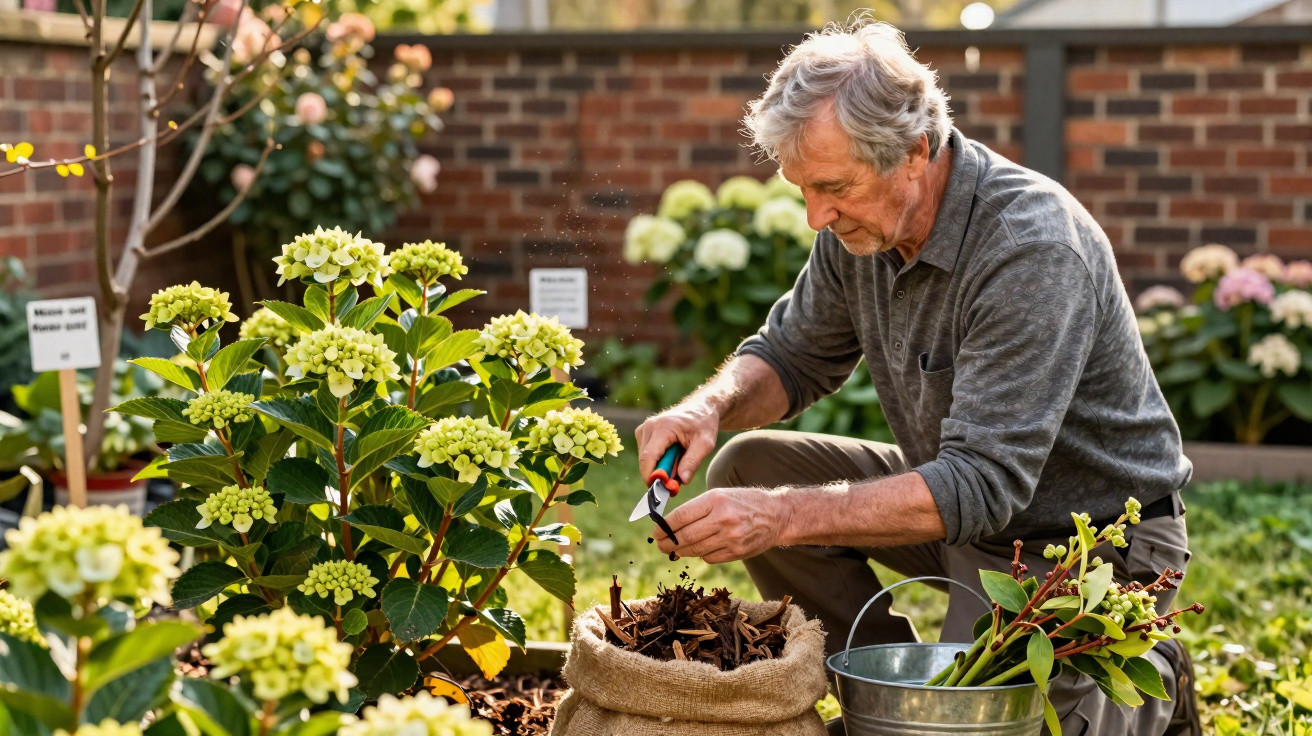
Monty Don, the British TV gardener, swears by a tiny but decisive March routine that can make the difference between a skimpy hydrangea summer and a truly spectacular one. It is not about pricey fertilisers or rare varieties; it comes down to impeccable timing and a very precise cut - paired with a straightforward winter mulching habit.
Why March determines hydrangea flowering
Hydrangeas are among the most popular flowering shrubs in UK gardens. In catalogue pictures they carry enormous pom‑pom blooms, yet in borders they often produce only a few flower heads atop lots of bare green growth. One of the biggest reasons is pruning at the wrong time - and in the wrong way.
This is especially true for classic bigleaf and lacecap hydrangeas (Hydrangea macrophylla). They form their flower buds the year before, on what gardeners call old wood. If you shorten those shoots hard, you remove the very buds that were meant to become summer flowers.
"The key point: many hydrangeas flower on last year’s growth. Pruning at the wrong time cuts off the next display straight away."
March is a tricky turning point. Buds begin to swell and the plant starts to wake from winter dormancy, yet nights can still be frosty. Monty Don argues that, in this window, you effectively decide whether your shrubs will later be covered in big, rounded blooms - or whether they will simply push lots of leafy growth.
Deadheading, not butchery: Monty Don’s spring mini-cut
A common problem is that two different actions get lumped together as “cutting back”. For experienced gardeners, there is a clear difference between removing spent flower heads and genuinely reducing a shrub.
- Deadheading: taking off only the old flower heads while leaving the shoots intact.
- Pruning back: shortening or removing stems to control size and shape.
Many people reach for the secateurs in winter and tidy hydrangeas “neatly”. The result is that the buds sitting in the wood since last summer end up in the garden waste. Monty Don therefore recommends a much gentler approach - and he specifically places it in March.
How the March trick works, step by step
Monty Don’s method is deliberate and almost minimalist:
- Choose the timing: late March suits best, once the harshest frosts have passed and the buds are visibly swelling.
- Check the plant: on each stem, locate the old, dried flower heads.
- Find the cut point: directly beneath the brown flower head you will usually see one or two pairs of healthy, plump buds.
- Make the cut: place the secateurs just above the highest strong pair of buds and remove only the spent bloom plus the scruffiest tip growth.
- Remove only dead wood: take out any fully brown, hollow or lifeless stems close to the base so light and air can reach the centre.
What matters is that most of each stem stays in place. The buds beneath the cut then break strongly and, in summer, carry the fat flower heads people are hoping for.
"A single cut a few millimetres above the right pair of buds can be the difference between two blooms and a whole shrub packed with balls of colour."
What to consider with different hydrangea types
Not every hydrangea responds to pruning in the same way. If you grow several kinds, it pays to know which is which:
| Type | Flowers on | Recommended pruning approach |
|---|---|---|
| Bigleaf / lacecap hydrangea (Hydrangea macrophylla) | Old wood | In March, remove only old flower heads just above the first pair of buds; avoid hard pruning. |
| Panicle hydrangea (Hydrangea paniculata) | New wood | Can be cut back more firmly in late winter or early spring, as flowers form on new growth. |
| Smooth hydrangea (Hydrangea arborescens) | New wood | Also tolerates a stronger cut, often down to a few buds above the ground. |
Monty Don’s “mini-cut” is aimed mainly at the classic garden hydrangeas that flower before June. One rule of thumb he has shared is: if a plant flowers before June, it is usually better not to cut it back hard in winter. That is where many of the most common home‑garden mistakes happen.
The overlooked partner: Monty Don’s winter mulching ritual
Alongside the fine pruning in March, Monty Don relies on a second, very practical measure: laying a generous layer of organic mulch in winter. It is not glamorous, but over time it acts like a wellness treatment for the root zone.
How Monty Don mulches his beds
In January, when the garden can look as if there is little to do, he spreads a substantial mulch around perennials and shrubs. His guidance translates easily to UK gardens:
- Material: well‑rotted compost, mushroom compost, chipped bark, leaf mould, or a mix of whatever your garden produces.
- Depth: at least about 5 centimetres, and ideally 10 centimetres. In his view, a thick layer over half the area does more than a wafer‑thin layer everywhere.
- Clearance: do not pile mulch against stems or the crown; leave a small collar clear to reduce the risk of rot.
This layer buffers sensitive roots against sharp temperature swings, helps the soil hold moisture for longer, and feeds soil life. For hydrangeas, that means stronger spring growth - the perfect partner to the targeted March cut.
"Stable roots, calmer soil, targeted pruning - that combination lays the groundwork for noticeably larger and more numerous hydrangea flowers."
Practical pointers for everyday gardening
If you want to try Monty Don’s approach at home, start with a single shrub. A few useful, real‑world tips:
- Do not prune in hard frost: mild, dry days in March or early April are better, and cuts seal more cleanly.
- Use sharp, clean secateurs: crushed stems weaken the plant and make it easier for fungal problems to get in.
- Look closely first: the crucial buds are often easy to miss, sitting right under the dry flower head.
- When in doubt, cut less: leave a stem and watch how the plant responds rather than overdoing it.
Many gardeners report that even in the first year, a gentler approach leads to far more flowers. The plant may not look dramatically different at first glance - but the number of buds increases noticeably.
Risks, special cases and helpful extras
There are, of course, exceptions. Very old, woody hydrangeas that have produced few flowers for years can sometimes benefit from a more drastic renovation cut - but you often have to accept a full season with fewer blooms while new flowering shoots develop.
Late frosts can also be an issue. In colder, exposed gardens, some people deliberately leave the dried flower heads in place for a little longer because they act like a small umbrella over the buds. In that case, the cut shifts towards late March or early April, once the risk has eased.
To round out the care, two more factors matter: watering well in dry spells and keeping the soil slightly acidic to neutral. Bigleaf hydrangeas in particular appreciate low‑lime water - in hard‑water areas, collecting rainwater can be worthwhile for pots and container plants.
Ultimately, the difference between a merely “fine” hydrangea and a truly impressive one is not special fertiliser or exotic varieties, but small routines: a gentle March cut, a proper dose of winter mulch, and a careful eye on buds and stems. Anyone who adopts that approach gets surprisingly close to the picture‑perfect hydrangea in their own garden.
Comments
No comments yet. Be the first to comment!
Leave a Comment