
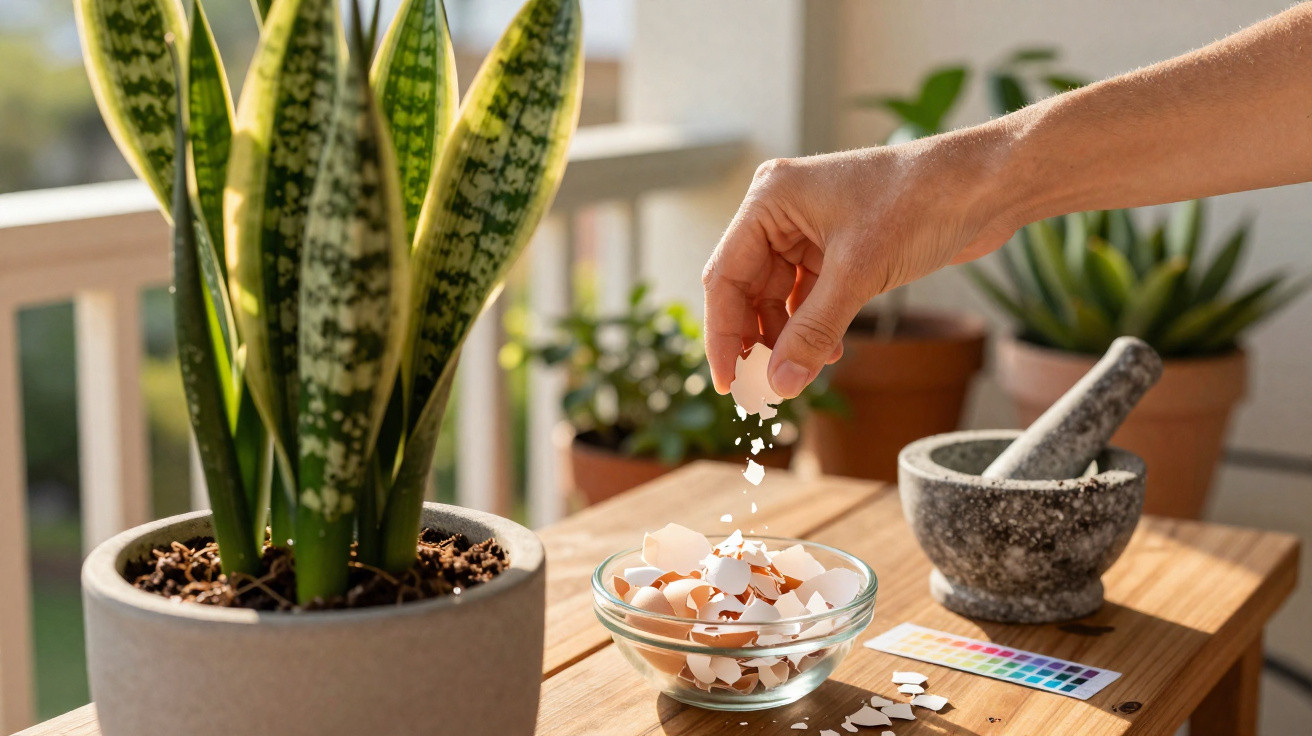
Crushed eggshell can be reused in a Saint George’s sword pot as a slow-release source of calcium, because it is made largely of calcium carbonate. When it is ground well and mixed into the growing medium, it breaks down faster than larger pieces and can gradually raise the pH of mixes that are overly acidic. The key point is not to mistake this for improved drainage: for this plant, preventing waterlogged soil remains far more important.
What does crushed eggshell do in a Saint George’s sword growing medium?
Eggshell mainly supplies calcium as its carbonate dissolves into the soil. This happens slowly-especially if the fragments are big-so crushing it into smaller particles increases the contact area and helps the mineral become available sooner. It can also act in a similar way to liming materials and, in sufficient quantity, may reduce the acidity of the substrate.
- Provides calcium with gradual release.
- Can raise the pH of excessively acidic substrates.
- Breaks down faster when turned into a fine powder.
- Lets you reuse a household waste product for plant growing.
How should you prepare the eggshell before adding it to the pot?
Remove any remaining egg residue, allow the shells to dry out completely, and then crush them until you have very small fragments or a coarse powder. The larger the pieces, the longer decomposition will take: agricultural extension materials note that big fragments can remain in soil for at least a year before releasing a meaningful portion of their stored calcium.
Once crushed, it is better to work a small amount lightly into the surface of the substrate, rather than creating a concentrated ring around the rhizome. There is no single at-home “correct dose” for pots, because the pH effect depends on the mix composition and its starting acidity. For that reason, adding a little is safer than tipping in multiple shells at once.
Does crushed eggshell really improve drainage?
Not in any meaningful way when it is properly ground. Drainage for Saint George’s sword depends far more on a porous potting mix and a pot that lets excess water escape. Coarse sand, perlite, pumice and other structural components are much more suitable for creating air spaces than eggshell powder. This species needs free-draining soil and can develop root rot if it stays saturated.
- Use a pot with drainage holes that are not blocked.
- Pick a light mix that does not stay compacted.
- Wait until the substrate dries out before watering again.
- Do not leave water sitting in the saucer.
- Treat eggshell as a mineral supplement, not a drainage material.
Why is too much water more dangerous for this plant?
Saint George’s sword has thick leaves and copes well with spells of low water, but its roots are vulnerable when they remain in continuously saturated soil. Horticultural sources point to root rot caused by overwatering as one of the species’ most common issues.
That is why adding calcium will not fix a pot that stays wet for many days. If the leaves begin to yellow, soften, or the base shows signs of rot, the first thing to check is soil moisture and the state of the roots. Standard care guidance is to let the mix dry between waterings and to cut watering frequency significantly during periods of slower growth.
When is it worth adding crushed eggshell to Saint George’s sword?
It makes the most sense as a moderate way to reuse a calcium carbonate source, particularly when the substrate is acidic and is not receiving other amendments or fertilisers rich in that mineral. Crushed eggshell is not a complete fertiliser, because it does not supply all the nutrients the plant needs in appropriate proportions, and extra calcium may be unnecessary if the mix already contains enough.
To keep Saint George’s sword healthy, the priorities remain a free-draining pot, spaced-out watering, and a substrate that does not hold water around the rhizomes. Finely crushed shell can be included as a slow-release supplement, but its value is in calcium and the potential gradual reduction of acidity-not in creating drainage or replacing the basic care that prevents root rot.
Comments
No comments yet. Be the first to comment!
Leave a Comment