
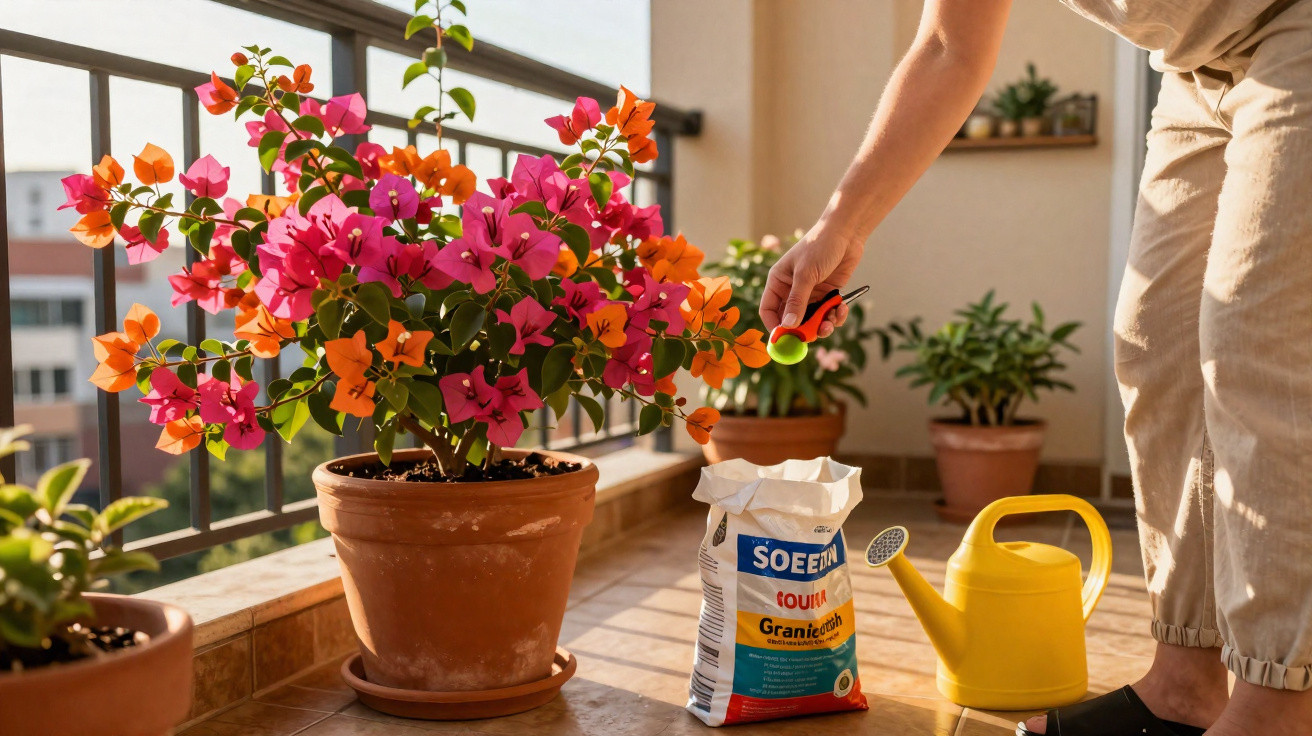
Having a balcony bursting with vivid colour is a common ambition for people living in today’s big cities. Bougainvillea is an ideal choice if you want striking beauty without complicated day-to-day upkeep in flat pots.
How do you choose the ideal pot for your bougainvillea to thrive?
This plant’s healthy progress is closely tied to how much room it has for its vigorous roots to spread. When it is kept in containers that are too small, growth is restricted and the roots struggle to take up the nutrients needed for a truly spectacular flowering display.
Specialists advise opting for a medium-sized container with an opening of at least 30 cm across. That size provides reliable support for long-term growing and reduces the need for frequent repotting on the balcony.
Keep these essential points in mind when choosing the container:
- Correct diameter: Make sure the top opening is at least 30 cm wide.
- Suitable weight: Medium pots are steadier against strong winds on higher floors.
- Effective drainage: Holes in the base prevent harmful water build-up around the roots.
- Hard-wearing material: Choose durable ceramic or high-grade polyethylene suited to urban conditions.
- Internal space: Allow the root system to develop freely for many years.
How much sun is needed for flowering?
Strong natural light is central to the metabolism of this hardy ornamental plant. Without direct sunlight, it tends to pour its energy into producing lots of green foliage, which can completely undermine the formation of those much-wanted flower buds.
For an ongoing, colourful show, aim for at least six to eight hours of full sun each day. Placing the pot where it receives intense direct light helps ensure spring looks its best on your flat balcony.
Below is a video from the YouTube channel Spagnhol Plants that explores the points covered in this topic in more detail:
How do you fertilise properly to encourage flowers?
Regular feeding is an essential tactic used by large commercial growers to speed up visible results. Unlike slow-acting organic mixes, targeted chemical fertilisers deliver soluble macro- and micronutrients that work quickly to induce new, long-lasting bracts.
Flowering secret
Avoid too much nitrogen
Fertilisers such as bokashi contain a high concentration of nitrogen, which mainly pushes leaf and branch growth.
For abundant flowers, choose blends higher in phosphorus and potassium, so the plant is fed more evenly in its pot.
Applying granular fertiliser once a month and lightly working it into the loose surface soil supports steady uptake of key nutrients. This careful routine keeps the growing medium fertile and ready to sustain repeated cycles of strong new growth in plants kept in full sun.
Use the following recommended feeds to maximise the plant’s beauty:
- A granular chemical fertiliser formulated for flowers, applied once a month.
- A water-soluble fertiliser high in phosphorus, diluted every fortnight.
- Bone meal or rock dust as excellent organic complements.
Why is pinch pruning essential for the plant?
Making deliberate cuts at the tips of the upper growth acts as a powerful, natural trigger for compact side branching. By removing the apical bud, you stop continuous upward growth and encourage new shoots that are packed with healthy flower buds during spring in a pot.
This simple shaping step should be done as soon as each full, intense flowering cycle finishes. It helps create a rounded, balanced form-ideal for making the most of limited space-and keeps a lasting display on urban flat balconies.
Follow these key steps to carry out the technique properly:
- Wait until flowering has fully finished and the bracts have dropped naturally.
- Use sharp, properly sanitised pruning shears.
- Trim the ends of all branches to remove the top apical bud.
- Encourage the immediate emergence of strong new lateral shoots along the sides.
What are the differences between “spring” (bougainvillea) species?
Knowing the common variations on the market makes it easier to pick the right option for compact set-ups. Bougainvillea glabra flowers along the length of its branches and responds very well to the frequent shaping prunes needed in medium pot conditions.
In contrast, the spectabilis type tends to flower mainly at the upper tips of its long, climbing growth. That habit makes it harder to keep a compact, home-friendly shape, so it can be more demanding and less suitable if you want maximum practicality on your urban flat balcony.
Read also: The classic Mediterranean garden climber that’s becoming a craze on modern balconies
Comments
No comments yet. Be the first to comment!
Leave a Comment