
Plenty of home gardeners plant zucchini every year, only to feel let down when the season ends with just a few skinny fruits hanging on the plant. A professional gardener now shares a straightforward watering tweak that can take a single plant to between 3 and 5 kg of zucchini - with no gadgets and no pricey products.
Why zucchini need so much water - and where people often go wrong
Zucchini originally come from warm climates and put on growth at pace. That speed comes with a trade-off: the big leaves lose a lot of moisture through evaporation. If you hold back on water, or water in the wrong way, you can end up with stunted fruit, disease issues, or even a plant that collapses altogether.
Two common mistakes show up again and again:
- Watering too infrequently, then trying to compensate with huge amounts.
- Watering only from above onto the leaves and missing the root zone.
"What matters isn’t the amount of water in one go, but how evenly and how close to the roots the plant receives it."
Zucchini generally cope well with two to three watering sessions per week - provided that around a 5-litre watering-can volume per plant actually soaks into the soil each time. The crucial point is letting the ground take up the water, rather than watching it bead and run off.
The ‘cuvette method’: a small basin with a big impact
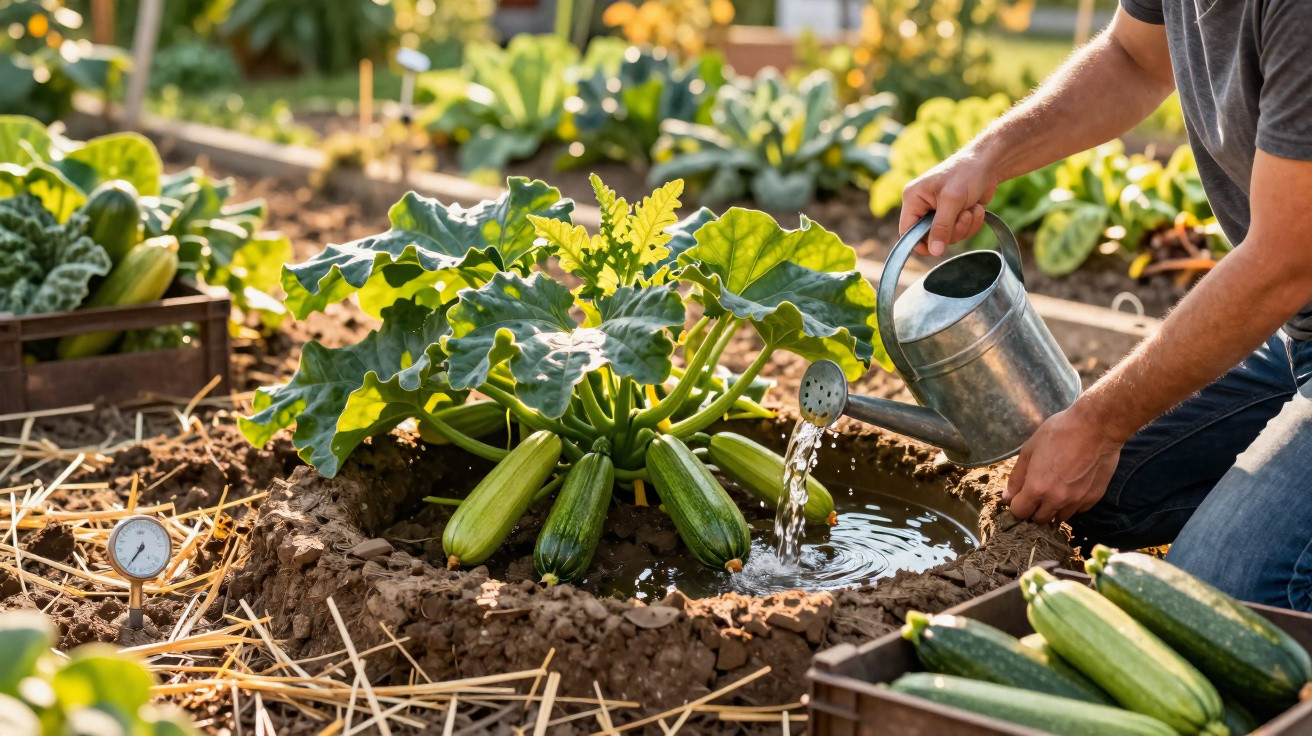
Garden expert Pierre, known from French television, describes a technique that sounds almost too simple, yet can make a major difference to yield: shape a shallow watering basin around each zucchini plant - essentially a mini crater in the soil.
How to shape the ideal watering basin
This approach works in an open bed and in a raised bed alike. You don’t need anything specialised - just a hand hoe, or even your hands:
- Loosen the soil around the plant in a circle of about 20–30 centimetres.
- Pull soil from the outer edge slightly upwards so it forms a low rim.
- Leave a dip in the centre, right by the stem - that dip is your watering basin.
- Take care not to damage roots, so don’t dig too deep.
When you water, the basin keeps the water in place instead of letting it spread away in all directions. The soil can absorb the moisture gradually, and the roots are supplied more consistently.
"The watering basin acts like a small reservoir: the water drains in slowly and reaches deeper roots, rather than sealing the surface into a crust."
Why ‘progressive watering’ works so well
The real trick is not tipping the whole lot into the basin in one rush. A staged approach is better:
- Pour in a first small amount of water and wait briefly.
- As soon as most of it has soaked in, water again.
- Continue until you reach about five litres per plant.
By watering slowly, you avoid creating a tough surface crust that often forms when a lot of water hits dry ground at once. This is particularly common on bare, sun-baked soil.
Mulch, temperature, timing: getting the most from the method
Alongside the watering technique itself, three other factors matter if you’re aiming for the 5 kg mark per plant: soil temperature, mulching, and planting at the right time.
Warmth is non-negotiable: plant only when the soil is ready
Zucchini are sensitive to frost. Planting out too early risks cold damage or months of slow, sulky growth in chilled soil. A simple rule of thumb:
- Start plants indoors or in a greenhouse in pots.
- Move them outside only once night frosts are no longer a risk.
- The soil should be consistently at least 12 to 15 °C.
If a plant goes into ground that’s too cold from the outset, root growth stays hesitant - and even perfect watering later on can barely make up for that poor start.
Mulch protects against drying out and surface sealing
Another lever for a strong zucchini crop sits right on top of the soil: mulch. A thin layer of organic material around the plant delivers several benefits at once:
- The soil loses moisture more slowly.
- Rain and watering don’t compact the surface as hard.
- Soil life stays more active, and roots are more comfortable.
Suitable materials include slightly dried grass clippings, shredded leaves, straw, or seed-free plant trimmings. Combined with the watering basin, this becomes a kind of “water management system” that suits zucchini extremely well.
How often you should actually water
How often you reach for the watering can depends heavily on the weather, your soil type, and how thick your mulch layer is. As a rough summer guide:
| Soil type | Weather | Watering pattern |
|---|---|---|
| Sandy soil | Hot, dry | 3 times per week |
| Loamy soil | Warm, changeable | 2 times per week |
| Good garden soil with mulch | Normal summer rainfall | 1–2 times per week (depending on rain) |
A practical check: push a finger about five centimetres into the soil inside the watering basin. If it feels dry down there, it’s time for the next can.
Harvest time: how to encourage new fruits
Zucchini can be relentless producers - if you allow them to be. The professional gardener’s view is simple: regular picking prompts more flowers and more fruits. Leaving fruits on the plant for “just a bit longer” repeatedly slows it down.
"Every zucchini you pick is a signal to the plant: ‘Keep going, make new fruits!’"
The ideal time to pick
Useful indicators for the best harvest moment:
- Length usually between 15 and 25 centimetres - depending on the variety.
- The fruit feels firm, but not hard like wood.
- You can separate the zucchini cleanly from the stem with a sharp knife or scissors.
If you harvest very early, you’ll get exceptionally tender fruits, but they don’t store well and shrivel quickly. Pick too late, and the fruits become watery and oversized, while draining energy that would be better spent on several smaller zucchinis.
Typical problems and how the watering method helps
Even with good care, zucchini plants sometimes cause concern. A few classic issues can be reduced - or avoided - by watering as described:
- Yellow leaves: May point to a lack of nutrients or waterlogging. A watering basin combined with progressive watering greatly reduces waterlogging.
- Rotting fruits: Often caused by fruit sitting on constantly damp soil. A good mulch layer helps because it dries more quickly and provides a gentler bed for the fruits.
- Fungal leaf diseases: Wet foliage, especially after evening watering, encourages fungi. Water in the morning or early evening directly at soil level, not over the leaves.
By delivering water in a concentrated way into the basin, the foliage stays relatively dry - an important contribution to overall plant health.
Useful additions: fertiliser, companion plants and choosing varieties
If you want to push yield as far as it will go, you can fine-tune a few things around the watering strategy. Three areas matter most: nutrients, companion planting, and the variety you grow.
Gentle feeding instead of a turbo shock
Zucchini respond best to steady, even nutrition. Good options include:
- Compost worked into the soil at planting time.
- A light organic liquid feed in the watering can every two to three weeks.
- Well-rotted manure or plant-based liquid feed at a low dose.
The watering basin is ideal for applying liquid feed right where it’s needed, without flooding the whole bed. The plant takes up nutrients at the point of greatest demand: the roots.
Good neighbours and smart combinations
Zucchini like to spread out, but they don’t have to dominate every bed. Good nearby choices include:
- Beans, which fix nitrogen and improve the soil over time.
- Pot marigolds and nasturtiums to attract insects and distract aphids.
- Onions or garlic, which may help deter pests around the root area.
Less suitable are close pairings with other heavy feeders such as squash or melons in a tight space - they compete strongly for water and nutrients.
Why the effort pays off
If you build the watering basin, water progressively, and pay attention to soil temperature, mulch and harvest timing, you’ll often notice the change within a few weeks: sturdier plants, more flowers, and more reliable fruit set.
Perhaps the biggest advantage is practical: with two or three well-cared-for zucchini plants, you can easily keep a whole family supplied - including neighbours who will happily take the odd basket of fresh zucchini. And you’ll know exactly how you achieved those quantities: with a simple, considered watering method delivered straight to the roots.





Comments
No comments yet. Be the first to comment!
Leave a Comment