
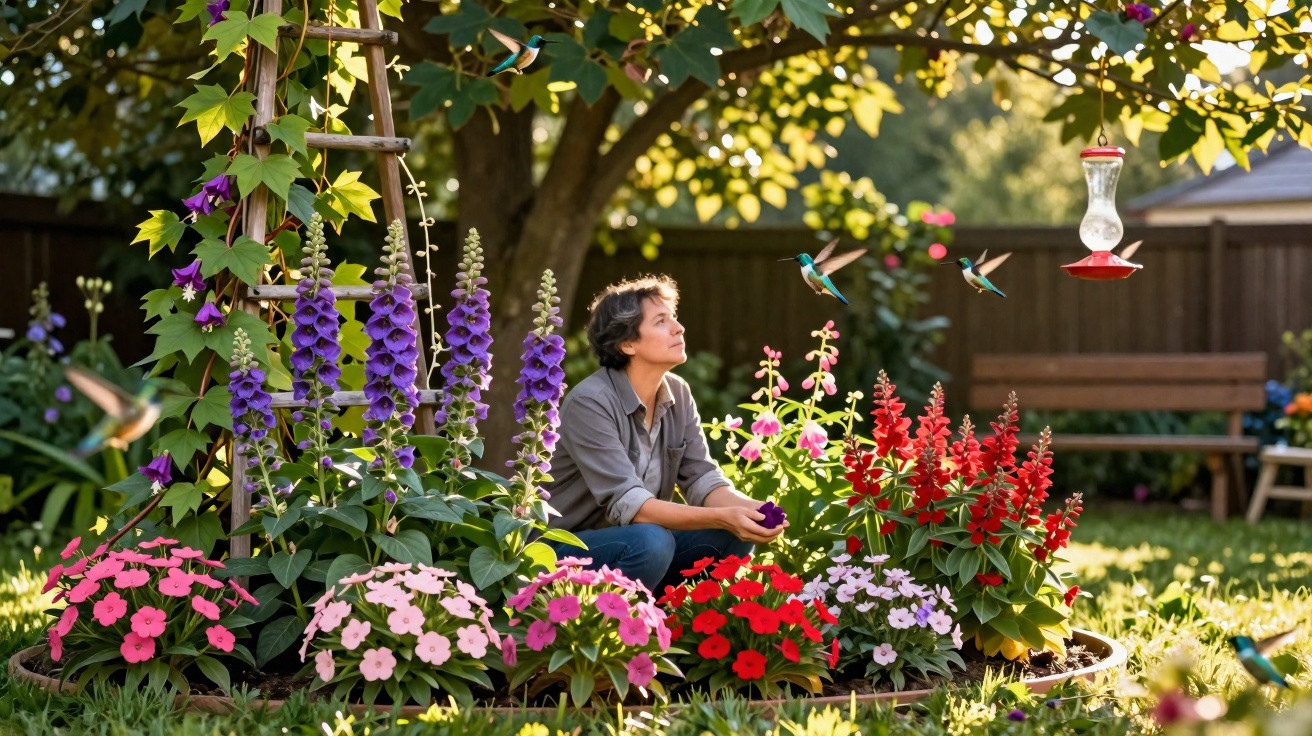
Many hobby gardeners give up on shady corners in frustration: nothing seems to flower properly, and everything looks dull and gloomy. Yet these spots can become the most interesting part of the garden - full of colour, movement and the hum of tiny wings. With the right planting, you can turn shade into a reliable feeding place for hummingbirds and other pollinators.
Why hummingbirds love shady spots
It’s common to hang up a red feeder, add a few bright flowers nearby, and then wonder why the birds simply zip past. The reason is their extremely energy-hungry bodies: their hearts can beat up to 1,200 times per minute, and their wings whirr dozens of times each second. They will only linger where nectar, shelter and calm are all available at once.
Hummingbirds don’t just seek “any” red blooms - they look for safe corners with lots of tubular, nectar-rich flowers at different heights.
Shady and part-shaded areas offer exactly that:
- cooler air on hot days
- less wind thanks to shrubs and climbing plants
- hidden nesting places at a safe height
- plenty of insects among leaf litter and damp soils
Experts note that hummingbirds usually build their nests several metres up, while feeding from flowers closer to ground level. That’s precisely why it pays to plan a shady area in “layers”: protective woody plants above, shrubs and climbers in the middle, and a ribbon of flowering plants below to supply nectar.
Shade isn’t all the same
Anyone who has casually dropped a perennial into a dark corner will recognise the outcome: a few weak leaves, then a slow decline. To avoid that, it helps to distinguish between different types of shade:
| Type of shade | Typical location | Characteristics |
|---|---|---|
| dry shade | right by the house, under overhangs | little rainfall, often low in nutrients, soil dries quickly |
| moist, cool shade | under deciduous trees | humus-rich, cool; relatively bright in spring, sheltered in summer |
| light part shade | north-facing balcony, fence lines, woodland edge | shifting light, usually good conditions for flowering plants |
Before planting, do a quick check: how damp does the soil stay, and how many hours of indirect light reach the area? Either way, a layer of well-rotted compost gives plants a strong start, and it’s best to use as little chemistry as possible, because hummingbirds also eat spiders and insects. A shallow dish of water, topped up regularly with fresh water, makes the spot even more inviting.
Creating a “hummingbird room” in the shade
A successful shady bed for hummingbirds feels like a small, sheltered room of greenery. It has a back wall, a leafy “ceiling”, and a colourful front of flowers.
A workable layout looks like this:
- Back: a trellis or fence covered with a vivid-flowering climber
- Middle: taller perennials with striking flower spikes
- Front edge: low, spreading bloomers and container plants
This doesn’t just create an attractive view for people - it forms a kind of “three-level buffet” for the birds. They can approach at different heights, duck into cover, and vanish again the moment a magpie or cat appears.
Five shade plants that hummingbirds rarely ignore
The following plants work well together and provide food and colour from spring well into autumn - even where the sun seldom reaches directly.
1. Busy Lizzie (Impatiens walleriana)
Busy Lizzie is rightly considered a star for shade. The plants stay compact, usually around 20 to 40 centimetres tall, and flower continuously right up to the first frosts.
- ideal for moist, cool shade and part-shaded beds
- grows well in the ground as well as in balcony planters
- dense planting creates a bright, carpet-like “landing zone”
Its glossy green leaves set off the intense flower colours beautifully. Key point: don’t let it dry out, especially in pots. In temperate climates it’s generally grown as an annual, as it only tolerates light frost.
2. Cardinal flower (Lobelia cardinalis)
If you have a damp, part-shaded area in the garden - for example by a pond edge or near a rain barrel - cardinal flower is worth trying. Its upright spikes of vivid red flowers act like little beacons.
This plant prefers fertile soil that stays consistently slightly moist. In the right position, it produces metre-high stems packed with individual blooms where hummingbirds can practically “park”. In very cold regions, it’s worth protecting it over winter with leaf mulch, or keeping container plants frost-free.
3. Bleeding heart (Lamprocapnos spectabilis)
Bleeding heart is a classic choice for romantic shade borders. In spring, rows of heart-shaped flowers hang from arching stems like a delicate garland. In hot weather the plant often dies back above ground in summer, but it returns strongly the following year.
A loose, humus-rich soil in light shade beneath shrubs or trees suits it best. Combined with later-flowering perennials, the space stays appealing even if the foliage disappears for a while.
4. Red honeysuckle (Lonicera sempervirens)
A climber adds structure in shaded areas. Red honeysuckle produces long, tubular flowers in warm red tones that match a hummingbird’s beak shape perfectly. Trained over pergolas, trellises or balcony railings, it creates sheltered corridors where birds can fly undisturbed.
It does best in part shade to lightly sunny spots, ideally with cool roots: shade at the base, light for the shoots. Regular pruning keeps it tidy and encourages fresh flowering growth.
5. Foxglove (Digitalis purpurea)
Foxglove provides vertical impact in a shady border. Its impressive spikes, densely filled with bell-shaped flowers, attract hummingbirds and bumblebees alike. It’s especially well suited to a light woodland edge where it catches some morning or evening sun.
Important note: foxglove is poisonous in all parts of the plant - not suitable for gardens where small children or free-roaming pets play.
Foxgloves often self-seed and reappear for years in different parts of the bed. If you’d rather control that, remove the seed heads in time.
The right mix for a lively play of shade
Combine these five plants thoughtfully and you’ll get a sequence of flowering that covers almost the entire gardening season. Early on, bleeding heart provides the first highlights; then cardinal flower and foxglove take over, while Busy Lizzie and honeysuckle keep going into autumn.
The more varied the planting, the more likely it is that butterflies, solitary bees and other beneficial creatures will join the hummingbirds. Once the plants are well established, maintenance drops noticeably: a few targeted waterings during dry spells, a little compost now and then, and a thin layer of mulch in autumn are usually enough.
Practical tips: from feeder to natural buffet
Artificial feeders can attract hummingbirds, but they don’t replace a natural supply of flowers. Used properly, they can support your planting plan:
- don’t position feeders directly above flowers to reduce squabbles
- hang several small feeders spaced apart instead of one large one
- change sugar water regularly and clean thoroughly so germs can’t build up
At the same time, avoiding pesticides helps keep insect numbers steady - an important protein source for the birds, especially during breeding season. Leaving a few dead stems or small piles of leaves also creates extra refuges for small wildlife.
Why shade zones have such huge potential
In many gardens, the sunny half is already packed with planting, while darker corners are treated as problem areas. Yet with the right shade plants, those very spots can become a distinct habitat with far less competition. Hummingbirds appreciate quiet, protected places where people aren’t constantly passing by and children aren’t playing.
So if you think your north-facing balcony or the corner beneath an old tree is a lost cause, it isn’t. With a considered choice of Busy Lizzie, cardinal flower, bleeding heart, red honeysuckle and foxglove, shade turns into a colourful stage set - and with a little patience, the first shimmering visitor will eventually arrive in search of nectar.

Comments
No comments yet. Be the first to comment!
Leave a Comment