
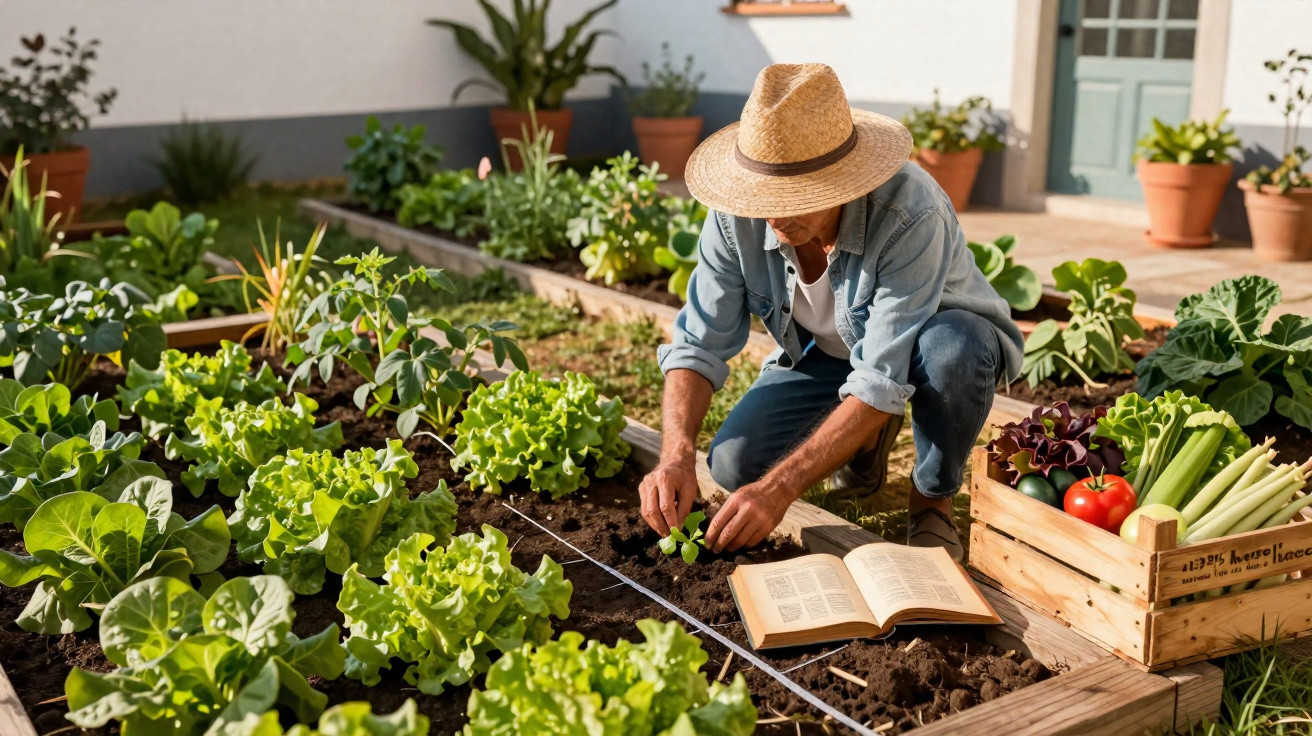
On a soaked Tuesday in March - somewhere between the third bout of drizzle and the fourth mug of tea - I found myself glaring at my sorry little London vegetable bed. Three drooping lettuces, two brave but runtish carrots, and a slug that looked entirely too smug. I’d done all the “right” things: raised beds, decent compost, endless YouTube tutorials, the lot. Yet for the space it occupied, the payoff felt borderline offensive - like paying for a full tank and being handed a fiver’s worth of petrol.
A few days later, an elderly neighbour casually leaned over the fence and mentioned that her mum used to grow twice the vegetables in a smaller patch when she was a child, “back in the twenties.” I smiled, mentally filed it alongside wartime anecdotes and ration-book lore, and moved on. Then, by chance, I came across a dusty gardening booklet from 1923 online… and it turned out she hadn’t been exaggerating in the slightest.
There really was a 1923 method for growing about 43% more vegetables in half the space - and it’s quietly making a comeback.
The Nearly-Forgotten Method Hiding in Old Allotment Books
To trace it properly, you end up in the early 1920s, with Britain still recovering from the First World War. Food supply was a serious concern, land wasn’t plentiful, and most gardeners couldn’t justify leaving soil empty for the sake of neatness or decorative spacing. In that climate, a handful of horticulturalists and allotment societies sharpened an approach they referred to as “intensive bed gardening” - a practical blend of tight spacing, deep soil work and thoughtful crop combinations. The aim wasn’t prettiness. It was production: more vegetables, less ground.
By 1923, gardening columns in local papers were already using phrases like “high-density plots” and “French-style intensive beds”. These weren’t raised beds in the modern Pinterest sense, with tidy timber borders and curated rustic charm. They were functional, even a touch ruthless. The soil was double-dug, compost was added generously, and seed was sown close enough that the foliage would knit together into a living roof over the earth. That leaf canopy held moisture, suppressed weeds by blocking light, and forced every bit of sunshine into something you could actually eat.
What stands out in those old notes is how methodical some of it was. Growers compared yields from traditional wide rows with their new intensive beds and logged improvements of roughly 40–50% per square metre. One 1923 allotment trial in the Midlands bragged of “nearly half again” the carrots and cabbages from an area other gardeners effectively surrendered to paths and bare soil. And then, gradually - as cheap food became easy to buy and gardens shifted towards ornament - the practice faded into the background.
So What Exactly Is This 1923 Gardening Method?
Once you look past the old-fashioned phrasing and sepia-toned photos, the basics are refreshingly straightforward. Rather than long rows with generous gaps and wide walkways, you form compact beds - often around 1.2 metres wide - and fill them with crops arranged in deliberate patterns. The key rule is that you never tread on the bed itself, only the paths around it, keeping the soil open and springy. In principle, every inch is either actively growing something or about to.
Spacing is tighter than what many seed packets still recommend. If current advice suggests lettuces at 30cm centres, the 1923 charts might push you to 20cm or less, using varieties selected for coping with close quarters. Carrots and onions are woven together in a chequerboard. Quick radishes are used to occupy gaps between slower brassicas. Deep-rooting parsnips are paired beneath shallower-rooted spinach. It’s less like setting out a parade ground and more like planning a dance.
Below the surface, the soil is treated as depth, not just ground. It’s worked down - often to two spade depths - and packed with organic matter. That’s the understated engine behind the headline “43% more veg” idea: the bed becomes a three-dimensional store of air and nutrients. Roots can push down rather than spreading sideways forever, so plants tolerate nearer neighbours. Old notes describe “two crops above the soil and one below,” a line that feels strangely current when you see the same concept diagrammed on TikTok in 2025.
The Maths Behind “43% More in Half the Space”
It sounds like marketing until you draw the layout. Traditional row gardening burns a surprising amount of area on margins and walkways. Rows are often given roomy paths “just in case”, and those paths can swallow 40–50% of the plot. Intensive beds do the opposite: paths narrow, beds take over, and you reclaim a large slice of land that was doing nothing.
After that comes the close planting effect. As leaves overlap, the soil stays shaded and the ground-level microclimate shifts. Evaporation slows, weeds struggle for light, and plants put more energy into growth rather than stress management. When modern trial gardens rebuild the 1923 pattern using today’s kit, they end up in the same ballpark: around 40–45% higher yield per square metre, and sometimes more - particularly with salads and root crops. Nothing magical happens to biology; you simply allow each plant to use the space you’re already paying council tax on.
Why It’s Suddenly Trending Again in 2025
It’s not hard to see why this approach has returned. Rents are steep, gardens are smaller, and allotment waiting lists in many UK cities have become quietly ridiculous. Plenty of people want to grow food, then look at a six-by-four metre patch and wonder whether it’s worth the trouble. When a method promises serious harvests from what initially resembles an oversized doormat, people pay attention.
There’s also a growing weariness with the Instagram version of gardening. Picture-perfect raised beds, colour-matched gloves and implausibly clean tools don’t reflect how most of us actually garden. Many of us grab five minutes of weeding between work emails and bedtime stories, often wearing entirely the wrong shoes. The 1923 method is oddly freeing: it’s indifferent to appearances. It only cares how much you can lift out of the soil and put on a plate.
And then there’s food prices. Anyone who’s stood in a supermarket staring at a limp £1.40 iceberg lettuce knows that flash of irritation. You don’t have to be a prepper to understand the appeal of producing real calories at home - even if “home” means a rented terrace with a narrow strip of yard. Those old bed diagrams are now being shared again in Facebook gardening groups, redrawn in bright colours and slapped with titles like “1923 Method – Double Your Veg”. Same idea, newly urgent.
The Emotional Pull of “Enough”
Beyond the arithmetic, there’s a quieter reason people latch onto it. Many modern gardens are designed for display: borders to impress, lawns to manage, patios to entertain on. A densely planted veg bed, filled edge to edge, communicates something else entirely. It says: this space is doing a job. This space is feeding someone. Stand beside a bed where leaves touch and the soil smells rich and alive after rain, and you can almost feel the low hum of it.
Most of us know the absurdity of pulling one skinny carrot from a plot that looked enormous on day one. The 1923 system reverses that sensation. You end up with handfuls of beans, armfuls of kale, and onions hanging neatly under the shed roof to cure - and it feeds a very old feeling of competence. Of “I made this happen,” even if some of the credit belongs to great-grandparents’ know-how.
How It Actually Works in a Small UK Garden
So what does it look like in practice, in a normal British back garden where the washing line always seems to cut through your plans? Imagine a bed about 1.2m by 3m - small enough to reach across without stepping on it. The soil underneath has been forked or double-dug, then improved with compost, leaf mould, whatever you’ve managed to gather from the council tip and your kitchen caddy. Instead of long rows, you divide it into blocks: a grid of beetroot here, a square of lettuce there, and a zigzag strip of spring onions threading between.
A single bed that size might hold, for example, 40 carrots, 20 lettuces, 30 onions, a scattering of radishes and a line of dwarf French beans on the sunnier edge. It sounds overpacked until everything fills in and you realise there’s hardly any bare soil left to see. Lettuce leaves help shade carrots. Onions discourage some pests. Beans climb just enough to take a string between two posts. Step back and, for once, the veg patch looks less like a pastime and more like a miniature farm.
The timing changes as well. Instead of sowing everything in spring and crossing your fingers, the 1923 approach pushes you into a steady, rolling cycle. Pull one lettuce and another seedling drops into the space. Radishes come out and beetroot goes in. You aren’t resetting the whole garden annually; you’re constantly revising one busy bed - and it becomes strangely addictive.
The One Thing 1923 Gardeners Did That We Dodge
Be honest: hardly anyone double-digs their entire garden every year, no matter how severe the old manuals sound. Most of us are juggling work, kids, Netflix, and a British climate that can’t decide what season it is. The 1923 gardeners, though, were uncompromising about soil. They went deep, piled in manure, and put organic matter back as if it were a moral obligation.
Today’s revival is gentler. Plenty of growers combine the old close-planting patterns with “no-dig” methods: topping up raised beds with compost, mulching heavily, and letting worms handle the hard labour. The principle doesn’t change - you still need rich, aerated soil that can support lots of roots in a small footprint - but the spade work is reduced. You don’t have to garden like a 1920s miner to borrow their yield figures.
What It Feels Like to Grow “Too Much” on Purpose
The first summer I properly committed to it, I made a predictable blunder. I followed the tight spacings while half-convinced they were optimistic - and then I doubled down. I added extra beetroot “just in case some failed”. Nothing failed. By July the bed had turned into a thicket. In the mornings, when I opened the back door, I could hear leaves brushing and thwacking softly against each other in the breeze.
There’s a mental shift involved: learning to thin and harvest with more intent. You snip baby lettuce so the bigger heads have room. You pull half-grown carrots for supper so the rest can swell. At first it feels wrong, like tidying a room that’s already tidy. Then you walk into the kitchen carrying a heavy colander of vegetables, still beaded with hose water, and you finally understand what “productive” looks like.
Your diet changes too, because the bed starts writing the menu. Too many courgettes? Courgette fritters, courgette soup, courgettes grated into everything short of breakfast cereal. A surplus of salad leaves? Suddenly you’re the person who shows up to barbecues with enormous, slightly chaotic salads. Friends roll their eyes - then ask how you managed to grow all of that from “just that tiny bed by the fence.”
Who This Old Method Really Suits (And Who It Doesn’t)
Intensive 1923-style gardening won’t suit everyone. If you love straight lines, bare rows and the clean look of visible soil, it may drive you mad. It’s busy, a bit untamed. There’s less space for wide paths and decorative borders. The bed looks permanently “full-on”, even when nothing dramatic is happening. And it asks you to get involved: lean in, lift leaves, and make small weekly choices instead of one big Easter overhaul.
But if you’ve got limited space and you actually want to eat from it, it can feel like cheating. It works well for renters with one strip they’re allowed to cultivate, families who want maximum return from minimal ground, and retirees who quietly miss the “dig for victory” mindset. It also suits anyone who enjoys lists, grids and the small thrill of squeezing one more cucumber between two cabbages. And it’s tailor-made for anyone who’s stood in a garden centre, stared at a tray of plug plants, and thought: where on earth is all of this supposed to go?
There’s something comforting, too, about using a system that has already survived a century of British weather, economic upheavals and shifting tastes. Fashions change. Seed catalogues get rebranded. Yet here it is again in 2025: the same close spacing, the same overlapping foliage, and the same quietly satisfied feeling when you stack another crate of homegrown veg by the back door.
Bringing a 1923 Idea Into Your 2025 Life
What makes this old-new approach appealing is that you don’t have to overhaul everything at once. You can dedicate one bed - or even a couple of large containers - as your “intensive test zone”. Find one of the 1920s grid diagrams (they’re everywhere online now), stick to the spacings even if they feel reckless, water properly, feed the soil, and see what the bed does.
You will get things wrong. Something will be planted too tight, something will bolt, and slugs will treat your first lettuces like a buffet. That’s normal. Gardeners in 1923 sent long letters to local papers fretting over cabbage spacing and carrot fly. The goal isn’t to recreate their lives; it’s to borrow their stubborn refusal to waste an inch of soil when that inch could be feeding someone.
Somewhere between our grandparents’ seriousness about food and our own craving for a greener, more tangible way of living, this method has caught a second wind. It turns small gardens into working gardens. It replaces bare patches with overlapping leaves. It makes four square metres feel, briefly, like enough. And if a century-old idea can do that while giving you 43% more vegetables from the same bit of ground, it may well be worth getting your hands properly dirty.


Comments
No comments yet. Be the first to comment!
Leave a Comment