
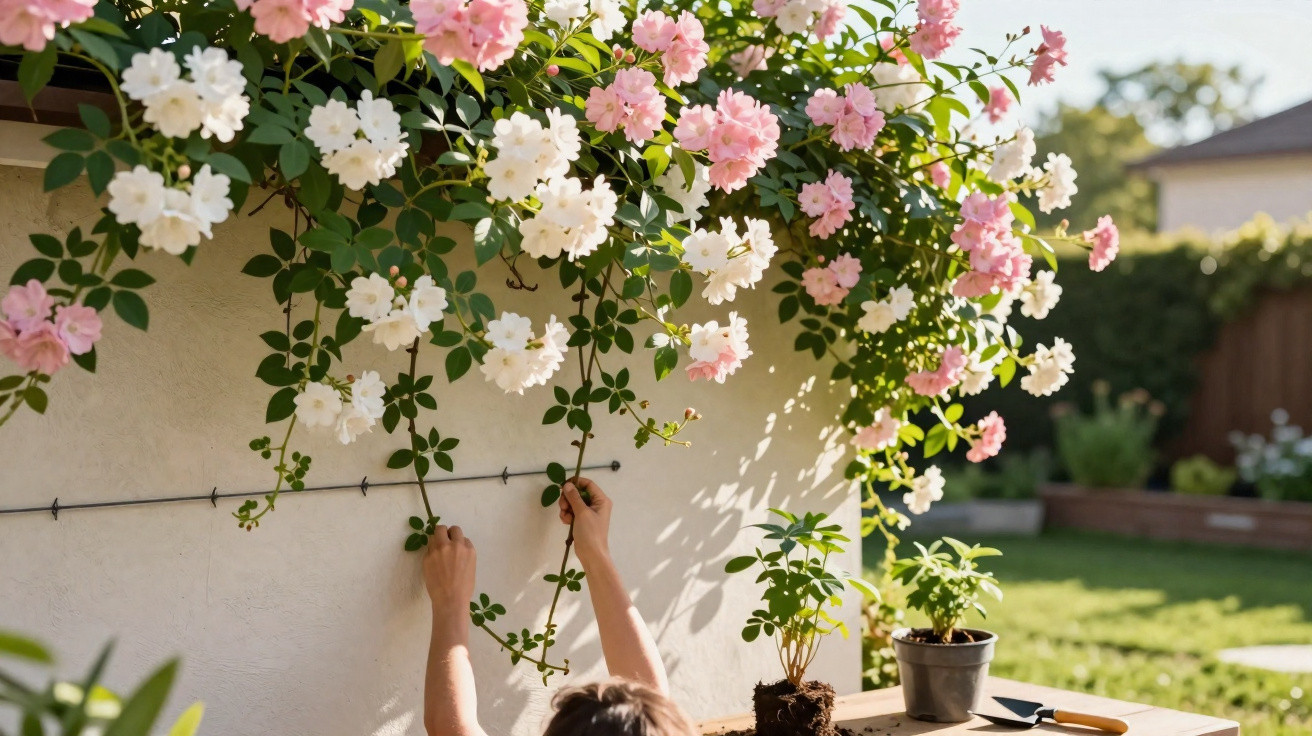
Wall covering with climbing plants often raises a familiar worry: the chance of harming the structure with aggressive roots or stems that creep into gaps. Among the choices available, climbers with non-invasive roots and continuous flowering stand out for anyone who wants a flowering wall without compromising plaster, brickwork or waterproofing-so long as everything from planting to pruning is done correctly and with a plan.
Why choose a non-invasive-root climber for a wall?
The main advantage of these climbers is a shallow root system that spreads in a controlled way and does not place meaningful pressure on foundations, paving or concrete structures. Because they feed from the upper soil layers, they are far safer in narrow border beds alongside the walls of houses and buildings.
Another key point is how they attach. In most cases, they are trained onto supports such as trellises, wires or metal frameworks, rather than using clinging roots stuck directly to the surface. This means the wall becomes a backdrop while the plant grows in front of it, creating a green, flowering screen with a lower risk of cracking, water ingress and moisture build-up.
How to grow flowering climbers in a practical and safe way
For reliable performance, these climbers need a few hours of direct sun each day; too much shade reduces flowering and encourages long, untidy shoots. The soil should drain well, contain organic matter and stay lightly, consistently moist without becoming waterlogged. A mulch layer made from bark or dry leaves can help.
Preparing the planting spot and the supporting structure is best done with a simple step-by-step approach that protects the wall and encourages balanced growth from the start:
- Dig a planting hole slightly larger than the plant’s root ball;
- Improve the soil with well-rotted organic compost;
- Set the plant 20–40 cm away from the wall;
- Put up wires, a trellis or mesh before growth becomes vigorous;
- Water frequently for the first few weeks, then gradually reduce.
How to train and secure stems without harming the wall
Careful training of the shoots is essential if you want an organised “green curtain” on the wall rather than a tangle that is hard to manage. The best option is to use discreet supports-such as tensioned wires, hooks, or wooden or metal trellis-fixed at a small number of well-spaced points.
As the climber develops, guide the main stems and tie them in gently with flexible strips to avoid constriction. It is also important to keep stems away from pipework, gutters and windows, to spread the weight evenly and to maintain good airflow between the foliage and the masonry surface.
How to prune and keep growth balanced over time
Regular pruning keeps vigour under control, refreshes the foliage and can encourage new flushes of flowers throughout the year. Typically, this involves frequent light trimming, while more severe pruning is saved for just after a heavy flowering period, helping to protect both the plant’s health and the overall look.
Useful ongoing tasks include removing dead or diseased stems, shortening overly long tips that creep towards roofs or electrical cables, and creating “windows” in the growth so light and air can pass through. Checking the plant’s base and the wall surface from time to time also helps you spot dampness or old cracks, ensuring a long-lasting flowering panel that looks attractive, suits the architecture and avoids structural damage.
Comments
No comments yet. Be the first to comment!
Leave a Comment