
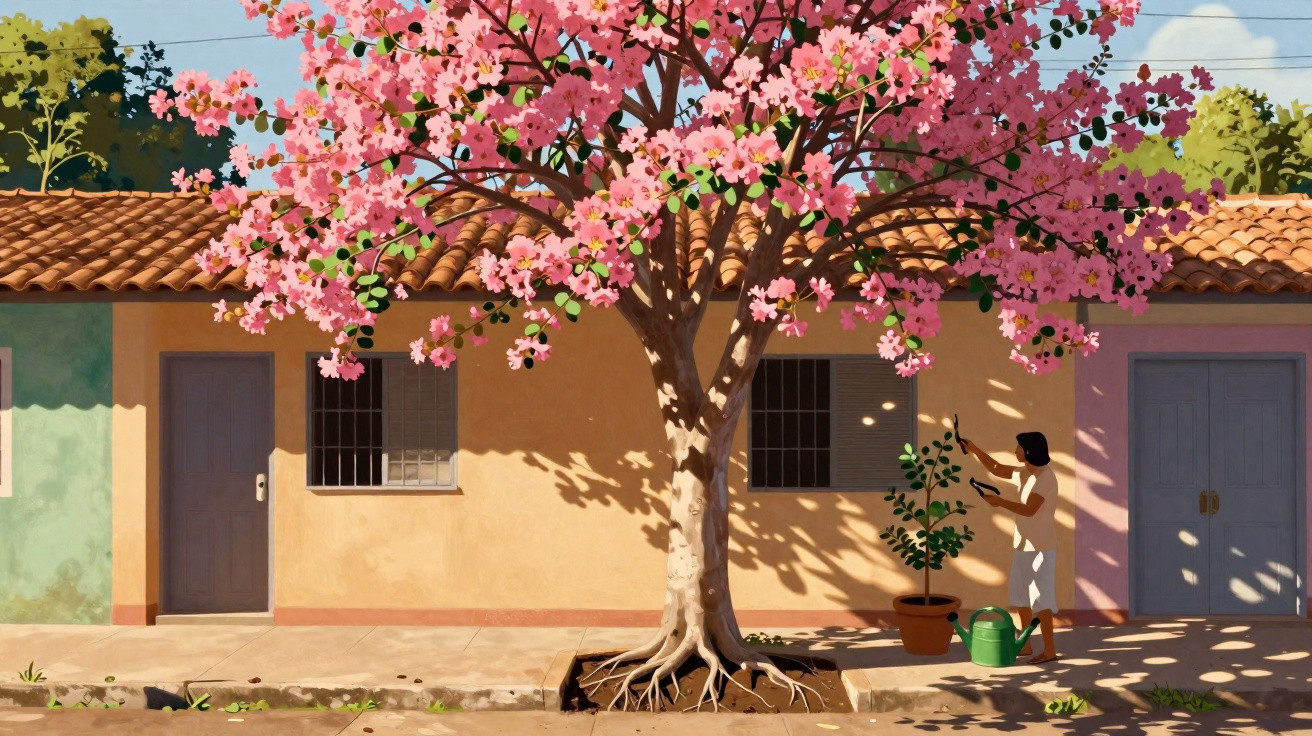
Choosing a tree to plant in front of your home in Brazil is a decision that should consider at least three practical points: roots that will not lift and crack the pavement over time, the ability to cope with strong sun and dry spells, and upkeep that does not demand weekly effort. Resedá (Lagerstroemia indica) meets all three requirements and still provides a striking display of pink, lilac and white flowers that can turn any frontage into a genuinely eye-catching garden.
Why doesn’t Resedá break pavements like other urban trees?
Most pavement damage caused by trees comes from species with shallow, aggressive root systems that spread horizontally just below the surface, pushing up concrete and paving stones within a few years. Resedá behaves very differently: its roots tend to grow downwards rather than outwards, meaning that even once the tree is fully grown, the surrounding surface usually stays intact. This is exactly why landscape designers have been recommending it more and more for residential pavements and small urban gardens.
Its medium size also helps it sit comfortably alongside built structures. Resedá can reach six metres in height, yet it responds well to pruning and can be kept shorter with straightforward annual cuts. A well-shaped canopy provides welcome shade for people walking past, and-when planted with the right spacing-does not interfere with overhead wiring.
- Heavy flowering in pink, lilac and white: clusters of blooms appear in the hottest months, turning the canopy into a showy feature for several consecutive weeks.
- Deep roots that do not damage paving: growth is primarily downward rather than sideways, helping protect pavements, surfaces and nearby foundations over decades.
- Tolerant of full sun and moderate drought: it handles the intense heat of the Brazilian summer and short dry periods without losing vigour, provided it is watered until established.
- Low litter: the flowers do not create a constant carpet that demands daily sweeping, unlike other ornamental species commonly used along Brazilian pavements.
- Prunes easily: it can be kept below its maximum six metres, making it workable even where electrical cables run nearby.
How to plant Resedá so it develops the ideal canopy shape
Formative pruning in the first years is what decides whether Resedá grows into an attractive, practical tree or becomes a messy, shrub-like plant. In the first two years, the aim is to encourage a single strong, upright main trunk by removing low side branches that emerge below 1.5 metres. This ensures that, once the canopy expands, there is clear space beneath for pedestrians to pass without snagging or getting hurt.
When planting, keep a minimum distance of two metres from the pavement and at least three metres from other trees so mature canopies do not overlap. Where pavements are narrow, Resedá can be trained into a more upright form through more regular pruning, keeping the crown compact and well above head height.
When and how to prune for more flowers next season
Resedá’s cleaning prune should be done in winter, when the plant is dormant and not in flower. At that time, remove dead wood, crossing branches and shoots growing towards the centre of the canopy, which restrict airflow. A shorter cut back of the outer branch tips, leaving only two or three pairs of buds, encourages fresh growth that will flower more heavily in the following spring and summer.
Care calendar for Resedá throughout the year
Four points in the calendar largely determine the plant’s health and flowering:
| Period | What to do |
|---|---|
| Winter (June to August) | Best time for cleaning and shaping prunes, taking advantage of dormancy. |
| Early spring (September) | Apply a compost or feed high in phosphorus to support the development of flower buds that will open in the following weeks. |
| Summer (October to March) | Peak flowering period; water more regularly during extreme heat and watch for aphids on new shoots, which are attracted to tender growth. |
| Autumn (April and May) | Lower-activity season; check the plant’s overall condition, inspect the trunk base for signs of fungi or pests, and prepare the area for the winter prune. |
Outside these key moments, Resedá needs very little attention, which makes it a smart choice for anyone who wants attractive landscaping without a weekly time commitment.
Aphids are the most common pest on Resedá, particularly on new shoots that appear after pruning. For light infestations, a strong spray of cold water directed at the colonies is often enough. If the problem is heavier, neem-based insecticides or potassium soap diluted in water work well and do not harm other beneficial insects such as bees, which are drawn to Resedá’s flowers during the flowering season.
Where to find saplings and what to check before buying
Nurseries that specialise in ornamental plants usually stock Resedá in a range of sizes and flower colours. When selecting a sapling, check that the trunk is sturdy and well formed, the leaves are green and unmarked, and the potting mix looks healthy and does not smell rotten. Saplings with a trunk already around two centimetres in diameter typically establish faster in their final position and reach their first flowering sooner than very small plants.
Flower colour is genetically fixed, so buying from a reputable nursery helps ensure you get exactly the pink, lilac or white you chose. Plants of unknown origin may not match the expected colour and will only reveal what they are at the first flowering, which can take a year or more.
Why Resedá is especially well suited to the Brazilian climate
Native to China and South-East Asia, Lagerstroemia indica has adapted extremely well to Brazil’s tropical and subtropical conditions. It copes with intense heat and high UV levels that defeat many imported ornamental species, and once established it tolerates moderate drought without needing constant irrigation. In areas with colder winters, such as southern Brazil, it drops its leaves in winter and returns strongly in spring, creating an appealing seasonal cycle across the year.
If you are considering planting a tree in front of your home and want to avoid cracked paving or excessive maintenance, Resedá is one of the most sensible choices currently available in Brazilian urban landscaping. Share this with anyone who is renovating their garden or frontage and is not sure where to begin.
Comments
No comments yet. Be the first to comment!
Leave a Comment