
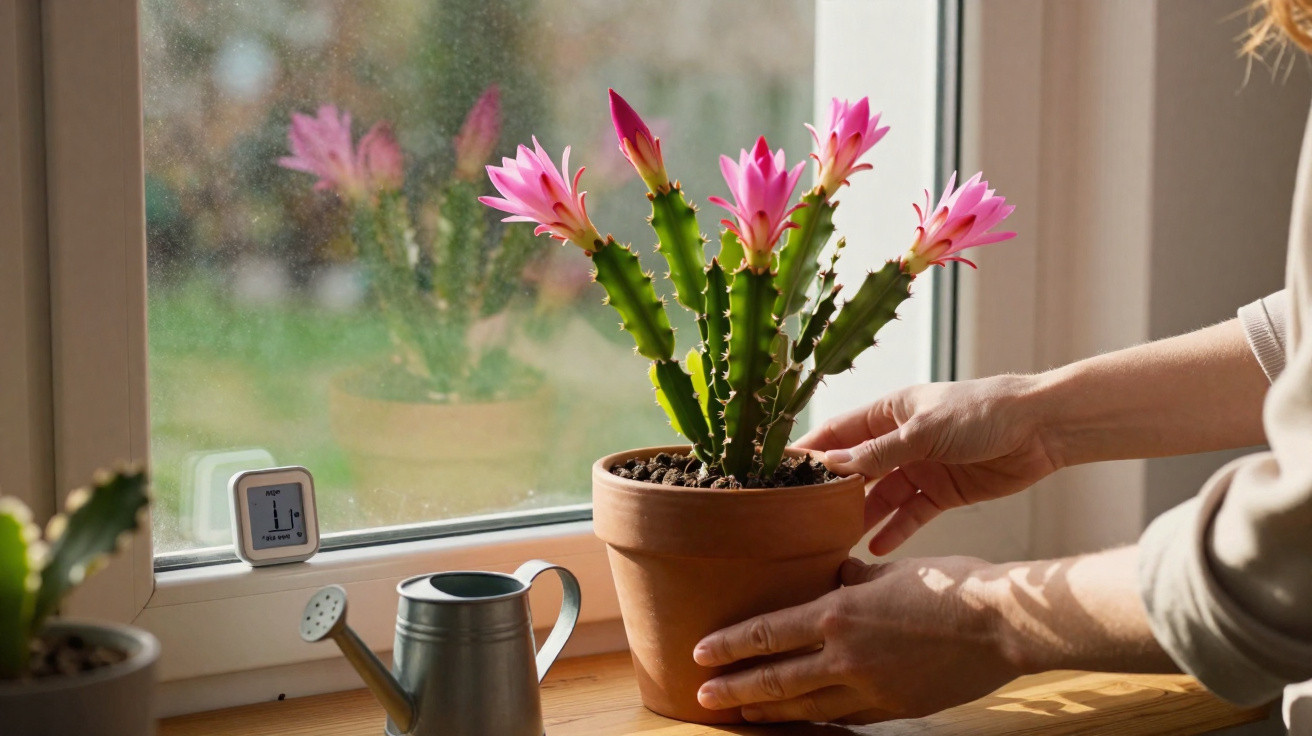
The pot looks perfectly healthy, the segments are a rich green, yet right on cue for the celebration-nothing happens. Not a single star-shaped bloom, even though last year it put on a real display of colour. If you care for an Easter cactus the same way you would a typical indoor desert cactus, you often (without realising it) shut down flowering-especially through winter.
What makes the Easter cactus so different
The Easter cactus (botanically Rhipsalidopsis, sometimes also listed as Hatiora) is not a desert plant. In its natural habitat-the humid forests of South America-it grows up in the trees, clinging to branches. There it receives:
- bright but filtered light
- an airy, constantly slightly damp growing medium made from decaying plant material
- fresh, fairly cool air without extreme heat
Those are exactly the conditions it wants indoors too-just in a pot. Unlike the far more familiar Christmas cactus, the Easter cactus flowers in spring, usually between March and May. Its segments tend to be rounder overall, and its star-shaped flowers sit upright.
If you treat an Easter cactus like a desert cactus-put it in full sun and keep it warm all the time-you will almost certainly stop it from flowering.
It only produces flowers when its annual rhythm is more or less on track. That means it needs a genuine rest period during the colder months-and this is precisely where most amateur plant owners go wrong.
The hidden annual schedule: how an Easter cactus “thinks”
Spring and summer: the growing season with moderate watering
During the warmer months, the Easter cactus grows actively. It forms new segments and lays the groundwork for the next flowering period. The best spot is bright but protected from harsh midday sun-near an east- or west-facing window, for example.
A clear watering routine helps:
- water every 7 to 14 days, depending on room temperature
- allow the top layer of compost to dry between waterings
- never leave water sitting in the outer pot or saucer
At this stage the plant can also handle a little cactus feed or a liquid fertiliser for flowering houseplants-kept weak, around once a month.
Autumn: slow things down
From late summer into autumn, the Easter cactus naturally reduces its growth. Your care routine should ease off as well:
- gradually extend the time between waterings
- stop feeding
- avoid repotting or heavy pruning
If the plant has been outdoors in summer, bring it back inside in good time-before night temperatures stay consistently below about 10 °C.
The decisive winter period: without a cool rest, there are no flowers
The most common reason for an Easter cactus that stays green but never blooms is winter that is simply too warm. On a windowsill above a radiator it may not look unwell, but it does not receive the clear signal it needs to set buds.
In winter, an Easter cactus needs a true rest period: cool, bright, and with very little water-otherwise it will not flower.
What the ideal winter rest looks like
From roughly November to January, the Easter cactus needs around eight to twelve weeks under these conditions:
- Temperature: 10 to 15 °C is ideal, with a maximum of about 16 °C
- Light: bright, but clearly less intense than in summer; no direct sun
- Day length: around eight hours of light, followed by real darkness
- Water: very sparing-often a small amount every three to four weeks is enough
“Lights out” really does mean dark. Constant background lighting from the kitchen, hallway, or even an aquarium can delay-or entirely prevent-the start of flowering. A cool stairwell window, a bedroom without evening lighting, or a rarely used home office is often a better choice than a permanently lived-in sitting room.
Watering in winter: less really is more
While resting, the compost must never become bone-dry, but it should dry out clearly between waterings. If you water “by feel” and tend to be generous, you can quickly end up with root rot.
A straightforward rule of thumb:
- test with a finger: if the top 2 cm feels completely dry, a small drink of water is fine
- tip out any excess from the saucer after a few minutes
- water less in cooler conditions than you would in warmer ones
Soft, glassy segments are a sign of too much water. In that case, the usual remedy is to dry the plant out immediately, remove any dead tissue and-if it is severe-repot into fresh, loose compost.
From winter rest to flowering: getting the timing right for Easter
After its cool break, the Easter cactus moves into early spring growth-most commonly in February.
- Move the pot to a brighter, slightly warmer position (18 to 20 °C).
- Increase watering a little, while still avoiding waterlogging.
- Once buds appear, avoid any drastic moves or changes of position.
Over the following weeks, suitable conditions encourage buds to form at the ends of the segments. At this point the plant becomes sensitive: temperature swings, dry air from heating, or draughts can quickly cause buds to drop.
As soon as buds are visible: no moving it around, no experiments, no full sun-stability produces flowers.
To raise humidity without soaking the compost, a simple method works well: stand the pot on a saucer filled with damp expanded clay pellets, ensuring the root ball is not sitting in water. This keeps the air around the plant slightly more humid while the compost stays on the drier side.
The biggest mistakes-and how to avoid them
| Problem | Typical cause | Solution |
|---|---|---|
| no flowers in spring | winter too warm, too much light at night, watering too often | 8–12 weeks of a cool rest period with little water and darkness |
| buds drop off | pot moved, draughts, strong temperature changes, air too dry | keep the position stable, avoid draughts, slightly increase humidity |
| segments turn soft | constant wetness, compost that drains poorly | free-draining mix, water more sparingly, no standing water in the outer pot |
| leaves/segments bleach | too much direct sun | move to bright, filtered light without midday sun |
The right compost for long-term flowering
Standard potting compost is often too heavy and compact for an Easter cactus. It holds too much moisture and does not allow enough air around the roots. A looser, free-draining mix is far better.
A proven option is:
- two thirds good-quality potting compost or cactus compost
- one third coarse material such as perlite, pumice, coarse sand, or fine pine bark
A pot with drainage holes is essential. A thin drainage layer of expanded clay or gravel at the bottom helps prevent water from collecting. Repotting the Easter cactus into fresh mix every two to three years in spring supports consistent flowering.
Why evening light throws off the flowering schedule
Easter cacti are among the plants that respond to day length. Too many continuous hours of light disrupt their internal calendar. Constant illumination from LED strips, a television, or lamps in the same room can mimic an endless summer-and slow bud formation.
A simple trick is to place the pot in autumn and winter in a room that genuinely becomes dark once daylight fades. Even setting it on the inside of a cool hallway cupboard overnight can help, as long as the temperature is suitable and the plant gets light again during the day.
Extra tip: fitting the Easter cactus into the rest of your houseplants
If you look after several houseplants, you can group the Easter cactus into a small “cool corner” with other plants that benefit from a winter rest, such as certain citrus plants or Mediterranean herbs in pots. Keeping them together at cooler temperatures makes care easier because you can adjust watering as a set.
The Easter cactus is also ideal if you are short on space: it stays fairly compact, does not need a large container, and-when treated correctly-can bloom again and again for decades. Once you understand that the winter rest is not a punishment but the start button for flowering, you are far less likely to end up with a green but silent pot.





Comments
No comments yet. Be the first to comment!
Leave a Comment