
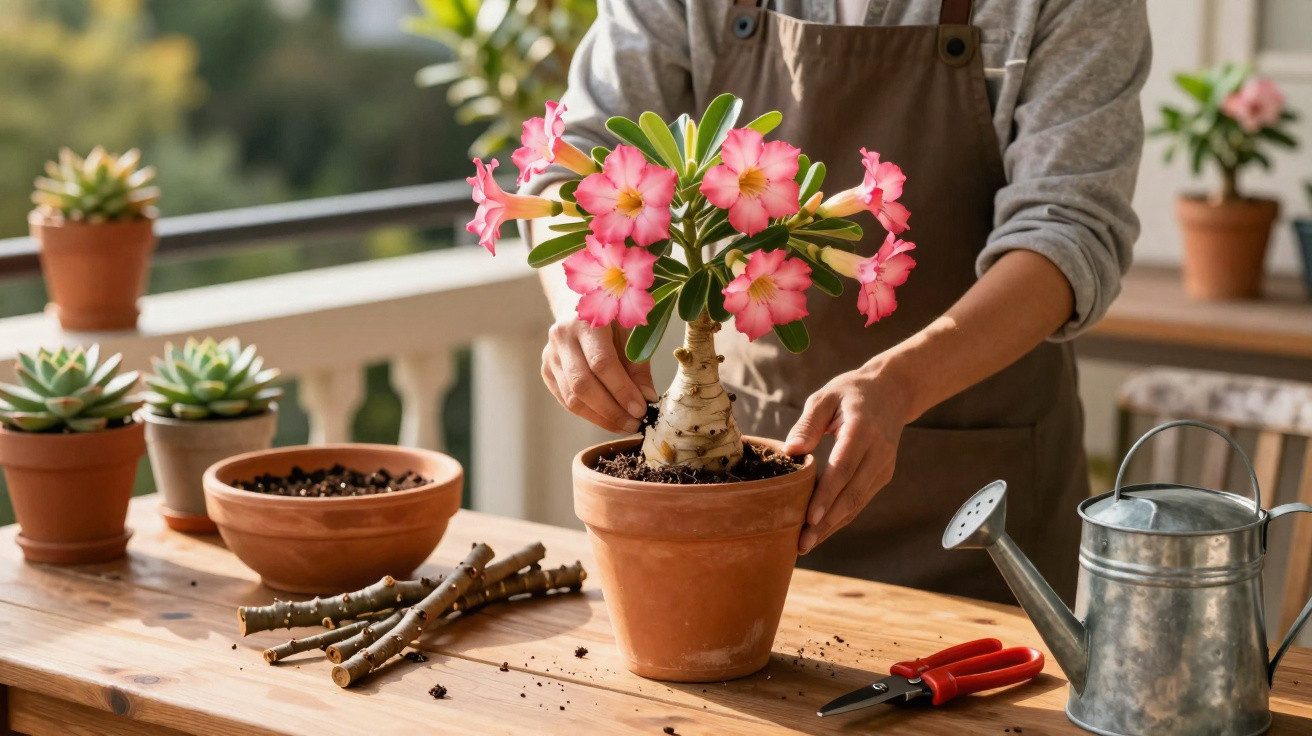
Growing ornamental plants at home adds a great deal of joy and beauty to family spaces. The well-known desert rose stands out for its singular, showy look, winning over gardening enthusiasts who want a vibrant garden with everyday practicality and efficient care.
How do you choose the best spot and potting mix for the plant?
As a desert-origin species, this plant needs a particular routine to grow strongly in UK homes. The first essential requirement for successful cultivation is to provide direct sunlight for at least six hours a day without interruption.
Alongside bright light, the potting mix also deserves close attention: it should be very free-draining to prevent harmful moisture build-up. Combining garden soil with fine grit helps create an ideal base, supporting healthy growth for its sturdy roots.
See the most suitable materials for setting up your plant at home:
- [Porous substrate]: Use pine bark and coarse-grade coconut fibre.
- [Full sun]: Prolonged direct exposure each day to encourage development.
- [Fine grit]: Add very fine gravel (often sold as “number zero”) to increase soil aeration.
- [Rock dust]: A silicon-rich mineral that boosts resistance to pests.
- [Slow release]: Controlled feeding via capsules to nourish the roots gradually.
What is the ideal watering routine to prevent rot?
Many households make serious mistakes by watering this plant too often, without taking into account its desert-adapted nature. The key to getting watering right is to soak it well only when the compost is completely dry, with no residual dampness.
Overdoing organic fertilisers can act like a dangerous sponge, holding water around the swollen stem. Opting for appropriate mineral fertilisers helps protect the plant’s base and supports attractive ornamental flowering on a balcony or in a back garden.
Below is a YouTube video from the Spagnhol Plantas channel that explores the points covered in this section in more detail:
How do you repot correctly using the right pot?
You’ll usually know it’s time to change containers when the plastic pot starts to visibly warp. Repotting at intervals frees up room for root expansion and encourages the full development of new, young branches.
Raising the caudex
Aesthetics and visual charm
During repotting, partially uncovering the plant’s swollen base reveals the natural beauty of the stem. This “lift” technique creates a sculptural look similar to a bonsai, making the plant more striking in a home garden.
To start preparing the new pot, always check there are enough holes in the base to allow water to drain quickly. Then add a generous layer of expanded clay balls or gravel to create efficient drainage safely.
Follow these main steps to build the structure of the new pot:
- Choose a pot that is only slightly larger to avoid excessive water retention.
- Place a drainage mesh over the layer of expanded clay.
- Fine-tune the plant’s height, keeping the “belly” of the plant visible.
Why is pruning essential to encourage new flowers?
Strategic cuts to the branches are the real secret to producing a compact shrub packed with healthy new shoots. Because the beautiful flowers form only on fresh growth, pruning is crucial for continually renewing the plant’s natural beauty.
This should never be done in winter or while the plant is actively flowering. The best time to prune is at the start of spring, ideally during the waxing moon for more practical results.
Use the following safety and best-practice steps when pruning branches:
- Fully sterilise blades and secateurs with standard alcohol.
- Make angled, slanted cuts to prevent water pooling.
- Apply ground cinnamon straight away as an excellent natural healing aid.
How can you use the cut branches to make new plants?
Throwing away the material from routine maintenance is a common mistake that’s easy to avoid with simple propagation by cuttings. Putting clean cuttings into damp sand or a porous substrate allows them to form a fully independent root system.
Beyond cuttings, propagation can also be done from seeds, which typically germinate quickly in around thirty days when conditions are favourable. With patience and consistent care, new plants flower within a year, successfully expanding the family’s botanical collection.
Read also: the secret to reusing pruned branches

Comments
No comments yet. Be the first to comment!
Leave a Comment