
Many home gardeners lose heart over bent, forked carrots - and the endless chore of thinning seedlings by hand.
A simple sand trick can prevent almost all of it.
If you want to get going in the veg bed in spring, you’re probably hoping for crisp, straight carrots rather than bizarre root sculptures. The good news is that a very easy - almost surprisingly effective - sowing method can give you neat, airy rows with little to no thinning, and it works from March onwards.
Why carrots so often end up crooked, forked and disappointing
Carrots have a reputation for being straightforward, yet in practice they drive a surprising number of gardeners up the wall. The reasons nearly always come down to two things: poor sowing technique and too little space per plant.
- Sowing too thickly: The tiny seeds drop in clumps, so seedlings crowd together and compete.
- Tangled roots: When young plants are too close, roots bump into each other, split and grow in all directions.
- Time-consuming thinning: If you thin later by hand, you often pull out good plants or damage neighbouring roots.
- Sowing too deep: Delicate seeds lose vigour, germinate late, or not at all.
"The key to straight carrots isn’t fertiliser - it’s spacing, and that starts at sowing time."
The method described here tackles exactly that. It helps the seed land evenly from the outset and gives each plant enough room. The result is less work, less frustration, and far better-looking roots.
The basics: good seed and the right timing
Which carrot varieties are worth sowing from March
If you’re starting early, choose early or mid-early varieties that cope well with cool, freshly warming soils. Seed packets often include wording such as “early”, “for early sowing”, or “early carrots”.
What gardeners can look out for:
- seed that’s as fresh as possible (check the best-before date)
- a variety note suitable for light to medium soils
- ideally organically produced seed for hardy plants
Depending on your region, you can begin sowing from March as soon as the soil is no longer waterlogged and hard-frozen. When you squeeze it, the earth should feel crumbly rather than sticky and smeary.
The real secret: mix the seed with dry sand
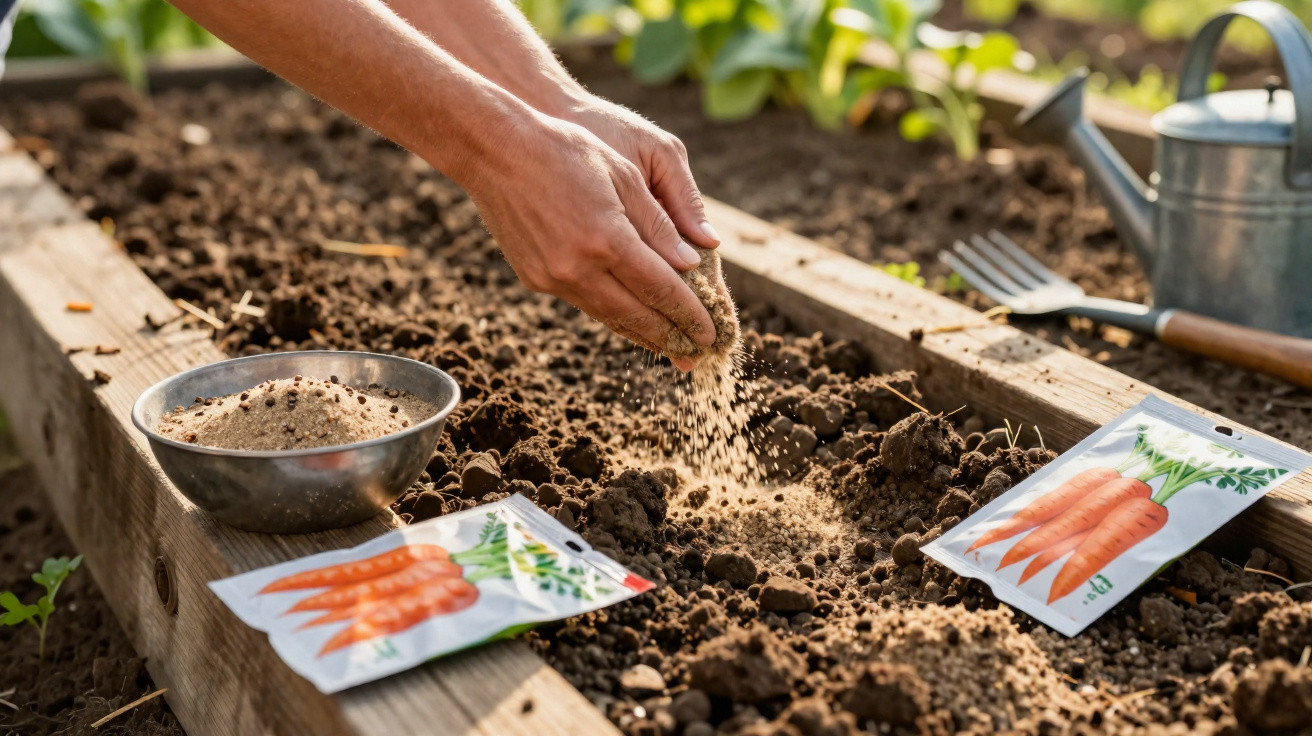
The decisive trick is to combine carrot seed with dry sand. This mechanically “dilutes” the fine grains and stops them landing in dense heaps in the bed.
The rule of thumb is straightforward:
- 1 part carrot seed
- 10 parts dry, fine sand
"This 1-to-10 mix replaces expensive seed tape - but works just as well, sometimes even better."
Use sand that is dry, clean and as fine as possible. Remove coarse grains and small stones beforehand. Play sand or washed building sand works well, as long as you let it dry out properly at home.
How to mix the “carrot seed powder” properly
Mix thoroughly until every seed is evenly dispersed
A small bowl, a bucket, or even a screw-top jar is suitable - what matters is mixing it really well.
- Measure out the amount of seed (for example, 1 teaspoon).
- Add ten times as much sand (for example, 10 teaspoons).
- Stir or shake vigorously several times until no seed clumps are visible.
The sand acts like a spacer for the tiny seeds. When you later sprinkle the mix into the drill, it naturally creates relatively even gaps - much like commercially made seed tapes.
How sand helps prevent forked roots
Most forked roots and twisted carrots have one underlying cause: direct competition. When two seedlings sit too close together, both try to form a strong taproot. They collide, divert, and split - and that’s how the classic fork forms.
"Where each carrot has its own tiny area from the start, a single straight taproot can develop without disturbance."
The sand creates exactly these “spacing islands”. It separates the seed so seedlings don’t push together like a dense lawn in the row. That removes the need for the usual, tedious thinning.
Sowing in the bed: shallow drills and generous row spacing
Sow shallower than most people think: about 1 cm deep
Before sowing, loosen the bed thoroughly. Remove old root remnants, stones and large clods so the carrots can grow downwards without hitting obstacles.
Then draw shallow drills using a tool handle or the edge of your hand:
- drill depth about 1 cm
- keep drills as straight as possible
- leave the soil at the sides loose, not compressed
Now sprinkle the sand–seed mix into the drills. The pale sand stands out against dark soil, so you can immediately see whether the line is even or whether there are gaps.
More important than you think: spacing between rows
Many carrot-bed problems begin not only within the row, but also between rows. If you plan too tightly, you’ll later battle mould, poor airflow and awkward weeding.
A proven minimum is about 25 cm between rows. That provides:
- good air circulation and fewer fungal diseases
- enough room for a hoe or your hand between rows
- clear paths you can move along while weeding
After sprinkling, close the drills gently with loose soil and lightly firm with the back of a rake. Press only enough to give the seed good contact with the soil - no more.
The tricky stage: keeping moisture up without washing seed away
“Moist, loved-up soil” - what the ground really needs now
Carrot seed germinates slowly and reacts badly to drying out. For the first one to two weeks, the surface must never dry out completely.
Use a fine rose on a watering can or a very gentle spray setting. You’re aiming for a soft film of water, not a downpour. The sand–seed mix needs to stay where it is, otherwise the spacing effect shifts.
"The soil should feel slightly cool and damp, but never muddy or left shining with standing water."
In cooler spring weather, careful watering every one to two days is often enough; in wind and strong sunshine, you may need to water more frequently. It’s better to water little and often than rarely and heavily.
Patience until germination: wait 10 to 20 days
Depending on soil temperature, the first carrot seedlings usually appear after 10 to 20 days. During this period:
- keep moisture consistent
- don’t step on the bed or compact the soil
- remove emerging weeds between rows early
If you like, you can cover the bed with a light horticultural fleece during germination. It helps keep moisture steadier, protects against heavy rain, and in some areas can also keep carrot fly away to a degree.
The payoff: rows without thinning stress and straight carrots
What you notice when thinning suddenly isn’t necessary
As soon as the first true carrot leaves appear, the advantage of the sand mix becomes obvious: plants stand far more openly in the row and rarely form a dense carpet.
"If you’ve mixed it properly, you’ll spend almost no time pulling out tiny seedlings by hand."
A quick check is still worthwhile. If a few spots do come up with several carrots very close together, you can thin just those areas with your fingers. That’s a brief touch-up rather than hours of punishment.
Harvest straight carrots - no magic, just method
At harvest time, the full benefit is clear. The roots sit separately in the soil, so they’re easy to grip and pull. Typical results in the bed include:
- noticeably fewer forked carrots
- more uniform root thickness within a row
- fewer damaged or misshapen specimens
Once you wash them, you’ll see how consistent the crop looks. The roots are easier to store, peel and cook with - a practical advantage you’ll feel in the kitchen.
Extra tips for a carrot bed with a professional look
Soil structure: a loose base instead of an obstacle course
Even the best sand mix won’t help much if the soil is full of stones and compaction. Carrots react immediately to barriers and veer left or right.
Before sowing, it’s worth working the soil thoroughly to at least spade depth. You can improve heavy clay soils with sand and well-rotted compost. Avoid fresh, strong manure, which often leads to distorted or cracked roots.
Make sensible use of rotation and companion planting
Carrots do best when close relatives (such as other umbellifers) weren’t grown on the same patch the previous year. Good preceding crops include lettuce, spinach or early kohlrabi.
A particularly popular pairing is carrots with onions in the same bed. Many gardeners swear the scent of onions confuses carrot fly. In return, carrots can help reduce onion fly pressure slightly.
Why this method is so appealing for beginners
The sand trick needs no specialist tools and no expensive products. A packet of seed, a bit of dry sand, and loose soil - that’s it. For beginners who’ve avoided carrots so far, it provides an everyday, workable approach.
Once you’ve seen how evenly carrots come up with this technique - and how much less effort it takes compared with the classic “sprinkle straight from the packet” approach - most people change their sowing habits for good. The move from crooked, forked frustration-carrots to straight, healthy roots is smaller than many expect - it quite literally fits into a handful of sand.

Comments
No comments yet. Be the first to comment!
Leave a Comment