
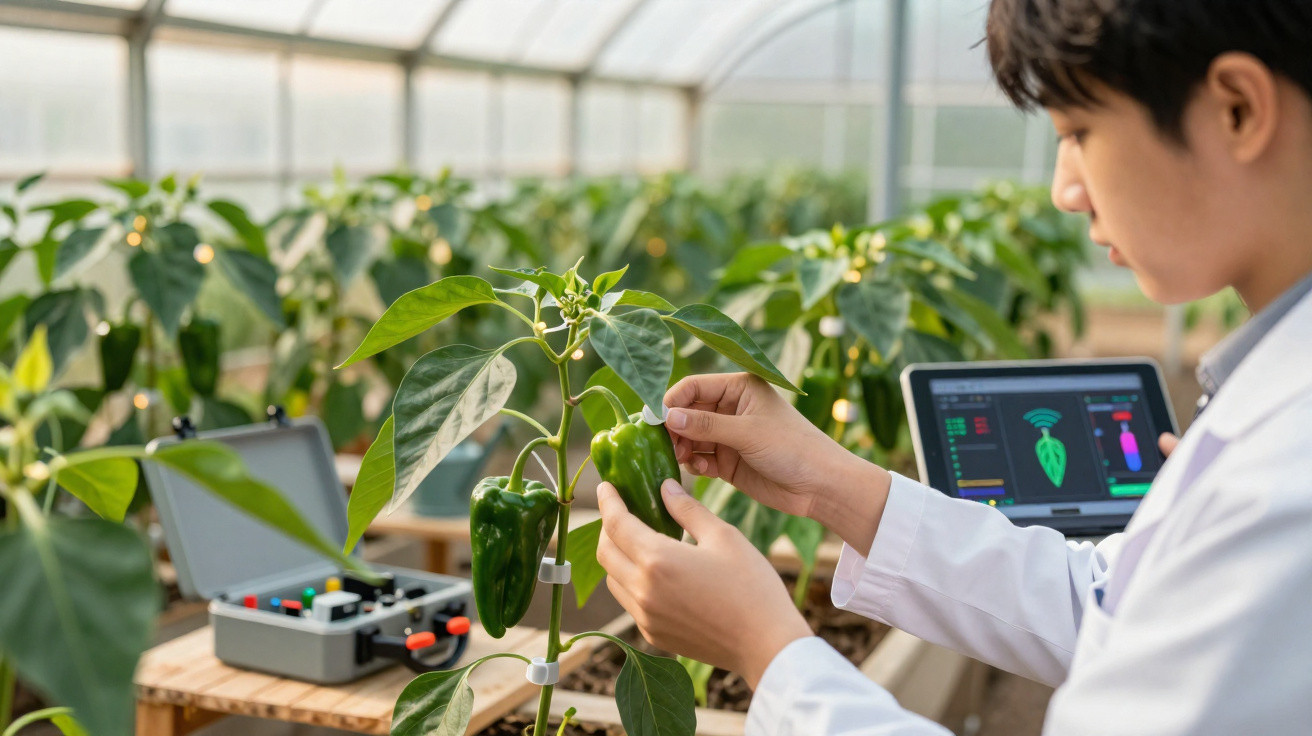
Smartwatches can log your pulse and flag up the effects of a poor night’s sleep. Until now, plants have had nothing remotely similar.
In farming, problems are often spotted only once symptoms are obvious - leaves begin to curl, growth slows, and the stress that triggered it may have been building for days.
A newly developed sensor platform aims to shift that timeline. Worn directly on the plant, it can register stress signals well before any damage becomes visible.
Detecting damage before it’s visible
A team of engineers at Tufts University has created two separate devices designed to attach to living plants.
One is an ultra-thin, tattoo-like patch that adheres to a leaf. The other is a flexible band that sits around the stem and is designed not to slide even when it is windy.
Used together, they track two key indicators. The leaf patch measures temperature and humidity just below the leaf surface, while the stem band monitors whether the stem continues to widen as the plant grows.
There is also an unexpected feature: the system does not need an external battery. Instead, it harvests energy from the moisture naturally evaporating from the plant.
“Other plant sensors exist, but their ability to track multiple stressors and growth-related parameters is limited, and the technology often relies on external batteries, which complicate field deployment,” said Nafize Hossain at Tufts.
Beyond the technology
Farmers already use a range of tools to observe crops from above. Satellites and drones, for example, collect visible, infrared, and microwave information across whole fields.
Those images can be used to chart greenness, patchy growth, heat patterns, pest impacts, and soil moisture. In addition, soil probes provide measurements such as moisture, temperature, pH, and certain nutrient levels.
Weather stations then complete the picture, recording air temperature, humidity, rainfall, wind, and sunlight exposure.
However valuable these systems are, they largely characterise the environment around plants - or they show damage that has already occurred.
The leaf-worn sensor takes a more direct approach by indicating how the plant is coping right now.
Early warning signs
“The leaf sensor is more of an early warning system showing how the plant is responding in the moment, before visible signs appear,” said Hossain.
“The larger promise is not merely that one plant can wear one sensor. It is that fields could one day contain networks of plant-level monitors, each reporting early signs of thirst, salt stress, disease or nutrient imbalance.”
Professor Sameer Sonkusale is an electrical engineer at Tufts University.
“While satellites and drones already give farmers a bird’s-eye view, plant wearables could offer a more intimate perspective of a plant’s-eye view,” said Professor Sonkusale.
Catching water stress
The leaf patch focuses on vapour pressure deficit (VPD), a metric that describes how strongly the surrounding air is “pulling” water from the plant.
When VPD is high, the air is dry and it draws moisture out of leaves. In response, plants close their stomata - microscopic pores that regulate gas exchange and water loss.
That protective response reduces dehydration risk, but it also curbs photosynthesis and slows growth.
Power from the plant
The moisture-sensing element is where the concept becomes particularly inventive. It uses vanadium pentoxide crystals that are separated into extremely thin nanosheets.
These nanosheets are layered within a membrane. A graphene sheet - made of carbon atoms - acts like a filter that allows plant moisture to pass through to the layers.
As water enters, ions form and move across the nanosheets, generating an electrical current. In this way, the leaf patch functions as both a sensor and a miniature battery.
The magnitude of the current corresponds to how much moisture the leaf is exchanging with the air.
Even so, the generated power remains modest, on the order of microwatts. Combined with low-power electronics and a small amount of energy storage, it is still sufficient to take regular readings.
Tracking the stem
The stem-worn device draws inspiration from kirigami, the Japanese practice of cutting paper to enable stretching and bending. The cut pattern allows the band to expand and contract with the stem rather than working against it.
A soft ion-conducting gel, known as a eutectogel, covers the sensor, and its electrical resistance changes as the stem thickens or narrows.
In general, a healthy stem broadens day by day, whereas stress can slow that widening or even cause the stem to shrink.
Sensors and timescales
Using both sensors together is important because plant stress appears on different timescales.
Leaves respond quickly to immediate conditions that influence water loss, while stem growth reflects a slower biological trajectory.
One device captures short-term shifts, and the other tracks longer-term change. Interpreted together, they provide a more complete picture than either sensor could deliver on its own.
Tested on bell peppers
To evaluate the approach, the researchers installed the system on bell pepper plants and used it to distinguish healthy specimens from those affected by water shortage or salt stress.
In healthy plants, VPD rose and fell in a regular rhythm, matching the normal day-to-day cycle of air moisture.
Plants under water stress showed VPD climbing steadily. By contrast, salt-stressed plants shifted in the opposite direction, with VPD lower than the controls.
The team suggests this reduction is likely linked to changes in water uptake and stomatal behaviour. Stem measurements supported the same conclusions from another angle.
Healthy plants continued to grow, whereas stressed plants either stopped widening or shrank altogether.
Built for the field
Agricultural environments are hard on electronics, so the leaf patch is designed to flex and stretch without tearing, while still allowing the leaf to breathe.
That pliability helps it remain functional on a moving, uneven leaf surface. On the stem, the kirigami structure spreads mechanical strain through the material.
This design choice helps it withstand abrupt shocks - such as a strong gust of wind - while maintaining reliable readings.
Wireless plant networks
Next, the team is working on a complete wireless connection for the sensors, experimenting with LoRa (a long-range standard) as well as Bluetooth-based alternatives.
With wireless reporting, sensors dispersed across a crop could transmit data without anyone needing to walk the rows.
The same platform could eventually extend far beyond moisture and heat. Later versions may be able to measure nutrients, plant hormones, and the earliest disease responses across roots, leaves, stems, and fruit.
Image Credit: Nafize Hossain

Comments
No comments yet. Be the first to comment!
Leave a Comment