
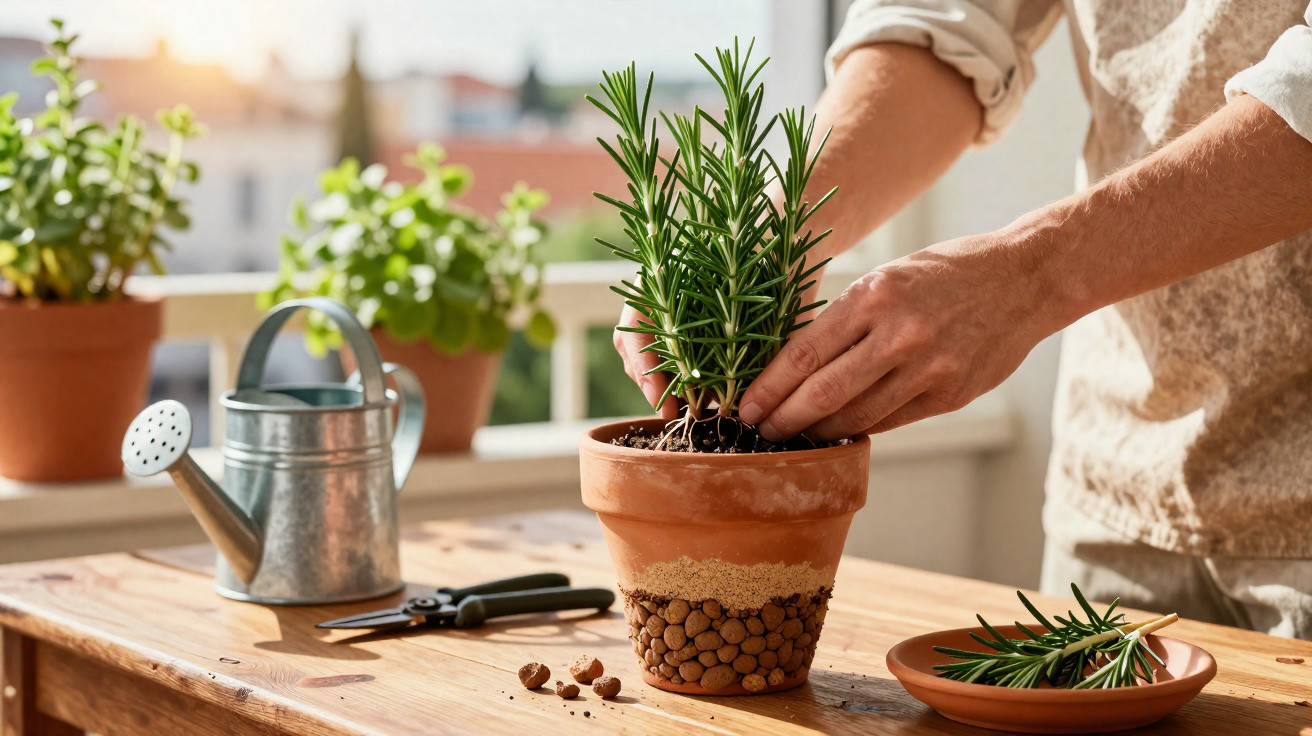
Anyone who has lost a rosemary plant without really knowing why has usually made the same mistake most people make: watering too often or choosing a pot with poor drainage. In the Italian tradition of growing Mediterranean herbs, the real secret to keeping rosemary going not for years but for decades sits at the base of the pot, before you even add compost. A generous layer of stones or expanded clay pellets at the bottom completely changes how the plant experiences water-and it can be the difference between a herb that thrives and one that quietly rots from the roots up.
Why does drainage matter more than watering frequency for rosemary?
Rosemary comes from Mediterranean coastal areas of Italy, Spain and Greece, where it naturally grows in stony, dry, free-draining ground that holds very little moisture. When you grow it in a pot in Brazil, especially in more humid regions, compacted compost can form a barrier that keeps water sitting around the roots for far longer than the plant can tolerate. The outcome is root rot, driven by fungi that flourish in exactly that damp, low-aeration environment.
What catches many people out is that waterlogged roots can produce signs that look like thirst: drooping tips, a greyish cast, and dull leaves. If you do not know this paradox, you water again and speed up the decline. The plant does not need more water; it needs the water it receives to drain away quickly, just as it would in the stony soils along the Italian coast.
- Expanded clay pellets or gravel at the bottom of the pot: a 3–5 centimetre layer creates a drainage zone that stops water pooling in direct contact with the roots
- A geotextile membrane (Bidim) between the stones and the compost: prevents compost from slipping down and clogging the drainage layer over time, keeping it effective for much longer
- A clay or terracotta pot with large drainage holes: the porous material naturally helps regulate moisture in the compost, and the holes underneath must be kept clear for drainage to work
- Compost mixed with coarse sand or perlite: increases porosity so air and water can move between particles down to the exit holes
- Agricultural lime or powdered eggshell mixed into the compost: slightly raises the pH, mimicking the limestone-rich Mediterranean soils that are rosemary’s natural habitat
How to set up a pot from scratch so rosemary lasts for years
The set-up starts before any compost goes in. First, check the pot has enough drainage holes, and that they are large enough to let water run out quickly. If there is only a single small hole, place one large stone over it before adding the drainage layer so the opening does not get blocked by compost. Then cover the base with a 3–5 centimetre layer of expanded clay pellets, gravel, or small stones. This is the step most people skip-and it is the one that makes the biggest difference.
On top of the stones, lay a piece of geotextile membrane (Bidim) cut to the pot’s size. This barrier keeps the stones and compost separate, stopping the compost from compacting and dropping down to clog the drainage over time. Fill with a light mix-ideally potting compost combined with coarse sand or perlite at a ratio of two thirds compost to one third sand. If you have access to agricultural lime, add a small amount to bring the pH closer to what rosemary prefers.
In this complete visual guide, you can see how to spot pests and restore your plant’s nutrition on the My Plants YouTube channel: https://youtu.be/O-7Fbz69ITo?si=ZJ2D_XGHF2ZVnAUh
How much sun does rosemary need, and how sunlight protects the plant from pests
Proper drainage tackles excess moisture in the compost, but sunlight tackles moisture in the air. Rosemary needs at least six hours of direct sun per day to build its essential oils, keep its characteristic fragrance, and produce tougher leaf tissue. Strong light exposure hardens the plant and helps evaporate surface moisture from both the compost and the leaves, creating conditions that make mites and scale insects less likely.
How to prune and harvest without slowing the plant’s growth
Two straightforward rules help rosemary bounce back with more growth after each harvest. Always harvest from the tips of the youngest shoots, cutting just above a pair of leaves. This prompts the plant to produce two new side shoots from the cut point, gradually making the rosemary denser, more branched, and more productive. Never remove more than one third of the foliage at once, so the plant retains enough energy for recovery and photosynthesis.
Cleaning pruning is different from harvesting: it removes dry, damaged branches or any growth showing signs of pests. You can do this at any time, without quantity limits, because you are only removing what is already compromised. Keeping the centre of the shrub open with good airflow reduces humidity between stems and lowers the risk of fungal problems, especially in tropical climates like those found across much of Brazil.
A light organic feed every three months completes the care routine. Rosemary is not a heavy feeder, so too much nitrogen-rich fertiliser can cause fast growth with less aromatic leaves that are more vulnerable to pests. A small amount of worm castings or diluted organic compost is more than enough to maintain vigour without going overboard.
What to do when rosemary starts wilting, even with correct watering
If rosemary looks limp, grey, or begins dropping leaves-even with moderate watering and adequate sun-start by checking the bottom of the pot. Put a finger into the drainage hole and see whether compacted roots or compost are blocking the exit. Another key clue is smell: compost that smells musty or rotten is a clear sign of long-term waterlogging, and fixing it may require lifting the plant out, inspecting the roots (removing any brown, soft sections), and repotting into fresh mix with proper drainage.
When rosemary is established correctly from the start, with good drainage and a sunny spot, it becomes one of the easiest and most rewarding plants you can grow. It largely looks after itself, asks for little, produces a lot, and can stay vigorous for years in the same pot. The Italian secret could not be simpler: prepare the right base before planting.
Share this with anyone who keeps rosemary at home and has never understood why it does not last. Sometimes the answer is literally at the bottom of the pot.


Comments
No comments yet. Be the first to comment!
Leave a Comment