
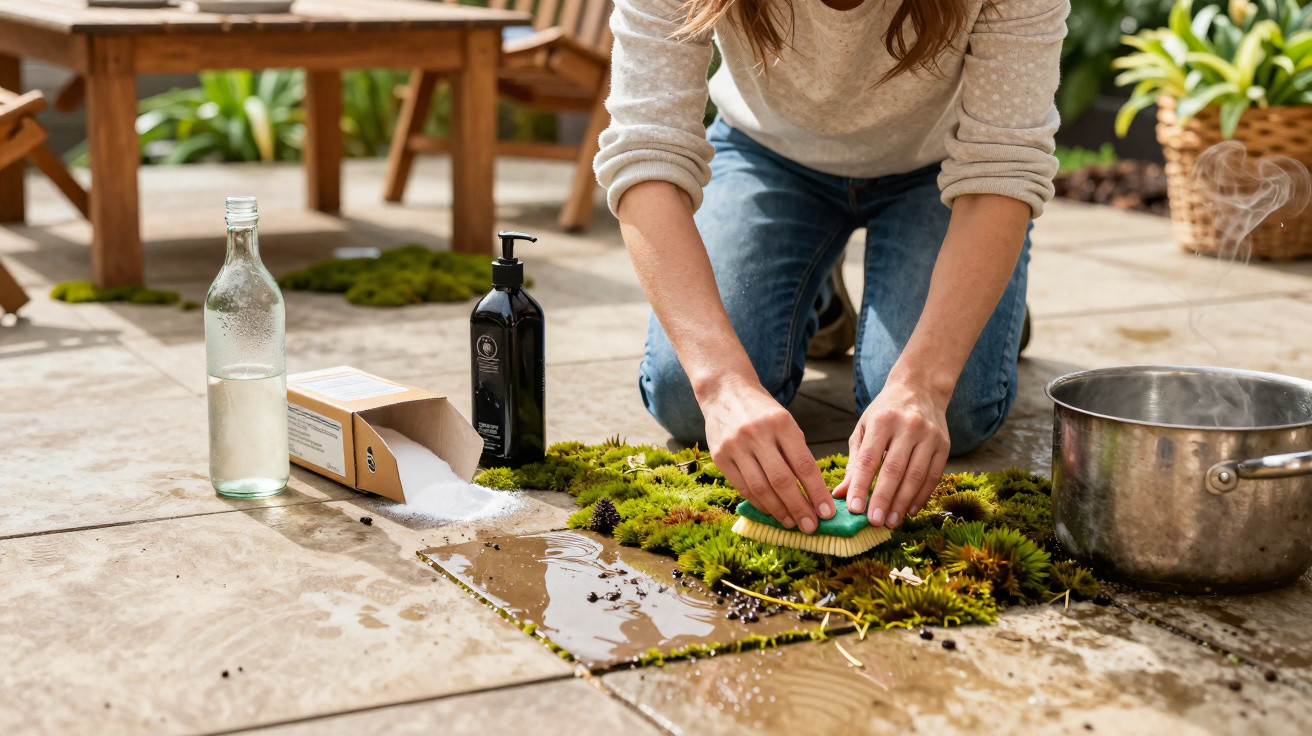
Spring sun finally reaches the garden, the chairs are dragged outside… and then you notice it: a slimy green sheen that’s turned your patio into something close to a skating rink.
All over the UK and the US, homeowners discover that winter leaves terraces coated in mossy build-up and the paving dangerously slick. Before you resort to harsh chemicals or industrial-strength cleaners, a few everyday kitchen staples can lift that green layer, look after your paving and make it safer for children and older relatives to walk on.
Why your terrace turns into a moss magnet
Moss thrives on three essentials: damp, shade and grime. By late winter, patios made from concrete, stone, brick or timber tend to offer the full set.
Rainwater washes dirt and pollution onto the surface. Leaves, bird droppings and soil tracked from flowerbeds create a thin organic layer. In damp joints and hairline cracks, spores settle, take hold and gradually spread.
Left unchecked, moss doesn’t just stain your slabs – it makes them slippery, traps even more moisture and speeds up wear.
Over time, paving can look darker and the joints can become packed with fibrous growth. On a wet morning, the surface may feel nearly as slippery as ice. That raises the odds of falls, especially for children rushing outside or older relatives relying on sticks or walkers.
Keeping on top of it makes a big difference. A thorough clean in spring and autumn, plus a quick weekly sweep through summer, is often enough to keep growth manageable. Many landscaping professionals argue that a broom and a bucket can outperform the latest “miracle” chemical spray.
Why skip bleach on your patio
Bleach can seem like the quickest fix: pour it on, the green vanishes, and you’re done. In practice, it comes with drawbacks.
- It may permanently bleach porous stone and coloured concrete.
- It gradually degrades grout and mortar joints.
- Run-off can damage lawn edges, ornamental plants and the living organisms in soil.
- If the area isn’t rinsed and left to air for long enough, children and pets can come into contact with residues.
Although bleach removes the visible moss fast, it doesn’t address the conditions that let moss take hold in the first place. After a few wet weeks, that green haze often returns.
Simple, mildly alkaline or acidic household ingredients often work just as fast on moss, with far less damage to surfaces and gardens.
Four kitchen ingredients that tackle moss better than bleach
1. White vinegar: the go-to patio rinse
A mix of white vinegar and water is one of the most reliable, easy-to-control options for removing moss from many hard outdoor surfaces.
For a patio clean:
- Mix 1 part white vinegar with 1 part warm water in a watering can or large bucket.
- Sweep the terrace to remove loose debris.
- Pour the solution generously over mossy zones and into joints.
- Leave for 20–30 minutes so the acidity can break down the green film and limescale.
- Scrub with a stiff brush or deck broom, then rinse thoroughly with clear water.
This is generally effective on concrete, most paving stones and outdoor tiles. If your patio includes delicate limestone or coloured slabs, test a small, inconspicuous patch first, as acidic solutions can lightly etch more vulnerable stone.
2. Baking soda: for deeply rooted patches
Baking soda (bicarbonate of soda) is mildly alkaline and slightly abrasive, which helps when moss is stubbornly clinging in shaded corners or wedged into tight joints.
One practical way to use it:
- Sprinkle baking soda directly on damp moss patches.
- Add a small amount of hot water to create a paste on the surface.
- Leave for 15–20 minutes.
- Scrub vigorously with a stiff brush, pushing the paste into joints.
- Rinse away residues to avoid white marks when the patio dries.
Baking soda is particularly handy for smaller zones, steps and the edges of raised beds where a pressure washer would be too aggressive.
3. Black soap: gentle clean with a protective touch
Traditional black soap (often made with olive oil and potash) works as a mild degreaser and general surface cleaner. It won’t knock back moss as forcefully as vinegar or baking soda, but it helps lift grime and makes the surface less welcoming for moss to return.
For a routine wash:
- Pour two tablespoons of liquid black soap into a bucket of hot water (about 8–10 litres).
- Apply with a broom or long-handled brush, working the solution into the surface.
- Leave a few minutes, then brush again to dislodge grime and light growth.
- Rinse or leave to dry if the surface tolerates it; a slight soapy film can have a mild protective effect on some mineral slabs.
This is ideal after you’ve cleared heavier moss using another method, or as a maintenance wash to keep a terrace in good shape through the summer.
4. Household soda and potato cooking water: unexpected allies
Household soda (washing soda crystals) isn’t the same as baking soda. It’s more powerful and should be used with gloves, but when applied correctly it’s still far kinder to paving and soil than many commercial moss killers.
| Product | Typical dosage | Main use |
|---|---|---|
| Household soda | 1 tablespoon per litre of warm water | Stubborn moss on mineral surfaces, away from plants |
| Potato cooking water | Used neat, while still hot | Light moss and algae, eco‑friendly clean-up |
For washing soda, prepare the mix, spread it across mossy slabs and joints, leave it for up to an hour, then scrub and rinse very well. Avoid nearby flowerbeds and lawns, and wear gloves because the solution can irritate skin.
Potato cooking water contains natural starches and a mild salinity that help weaken moss. After boiling potatoes, take the hot water straight outside, pour it over green patches, then brush once it has cooled slightly. It’s most useful for light growth and as a “bonus” clean when you are already cooking.
Making sure the moss doesn’t come back
Once the slabs are looking fresh again, preventing regrowth is usually about consistency rather than stronger chemicals.
The cleaner and drier your patio stays between rain showers, the less chance moss has to return.
Practical steps include:
- Checking drainage so water doesn’t pool on low spots.
- Brushing leaves and soil off weekly, especially in autumn.
- Using outdoor rugs under dining tables or barbecues to catch food spills.
- Cutting back overhanging branches to let in more light and air.
Some homeowners also use a diluted coating of linseed oil on bare concrete or natural stone. When mixed with three parts water and brushed on lightly, it can gently saturate the surface and reduce water penetration, which moss tends to dislike. It should never be used where slip risk would be high when wet, and it’s sensible to test a hidden corner first.
Common mistakes that damage slabs
On terraces, two culprits cause the most issues: bleach, and pressure washers turned up too high.
With pressure washers, the problem is usually technique rather than the machine itself. If the lance is held too close-under 30 cm-it can chip paving, roughen smooth concrete, and blow jointing sand or mortar out of the gaps. That creates spaces where water sits, and moss often returns faster than before.
Overly concentrated cleaners, along with home-made salt mixes, can also backfire. Salt builds up in soil and may kill nearby plants, while very strong alkaline solutions can burn skin and permanently mark certain stones. If you do use stronger agents, keep them for small mineral areas and rinse generously before children or pets use the space again.
How often should you clean a moss-prone patio?
How regularly you’ll need to clean depends on your climate and the patio’s position. A shaded, north-facing courtyard in a wet region will turn green far sooner than a sun-baked terrace in a drier area.
As a rough guide:
- Heavy clean: once in spring after the last frosts, and once in autumn after leaf fall.
- Light clean: every one to two weeks in wet spells – a broom and a bucket of soapy water are usually enough.
- Spot treatments: use vinegar or baking soda on new moss patches as soon as you notice them.
Following this pattern helps you avoid the familiar cycle: ignoring the moss for years, then needing aggressive chemicals-or paying for an expensive professional clean-to make the space usable again.
When to consider professional help
Some jobs aren’t ideal for DIY. If you’re dealing with heritage stone, intricate paving patterns, or a large terrace around a pool, professional cleaning can be a safer financial choice than risking damage with the wrong approach.
A specialist can identify the stone type, judge how porous the slabs are, and check the state of the joints before choosing a method. They often use low-pressure rinsing alongside carefully measured biodegradable cleaners, which can be reassuring if your patio is close to a pond or stream.
Extra tips for safer outdoor living
Clearing moss is only one part of making a patio safer. After washing down, inspect the slabs and joints closely. Cracks, loose edging and missing grout can all trip people up and allow water to seep in. Small fixes-fresh jointing sand or mortar where needed-prevent minor problems becoming costly structural repairs.
If you have toddlers or older relatives at home, picture a wet-day routine. Which route will people take from the back door into the garden? Keeping those main lines of travel especially clean, placing a non-slip outdoor mat by the door, and improving lighting around steps will reduce the risk of slips more than any single cleaning product.


Comments
No comments yet. Be the first to comment!
Leave a Comment