
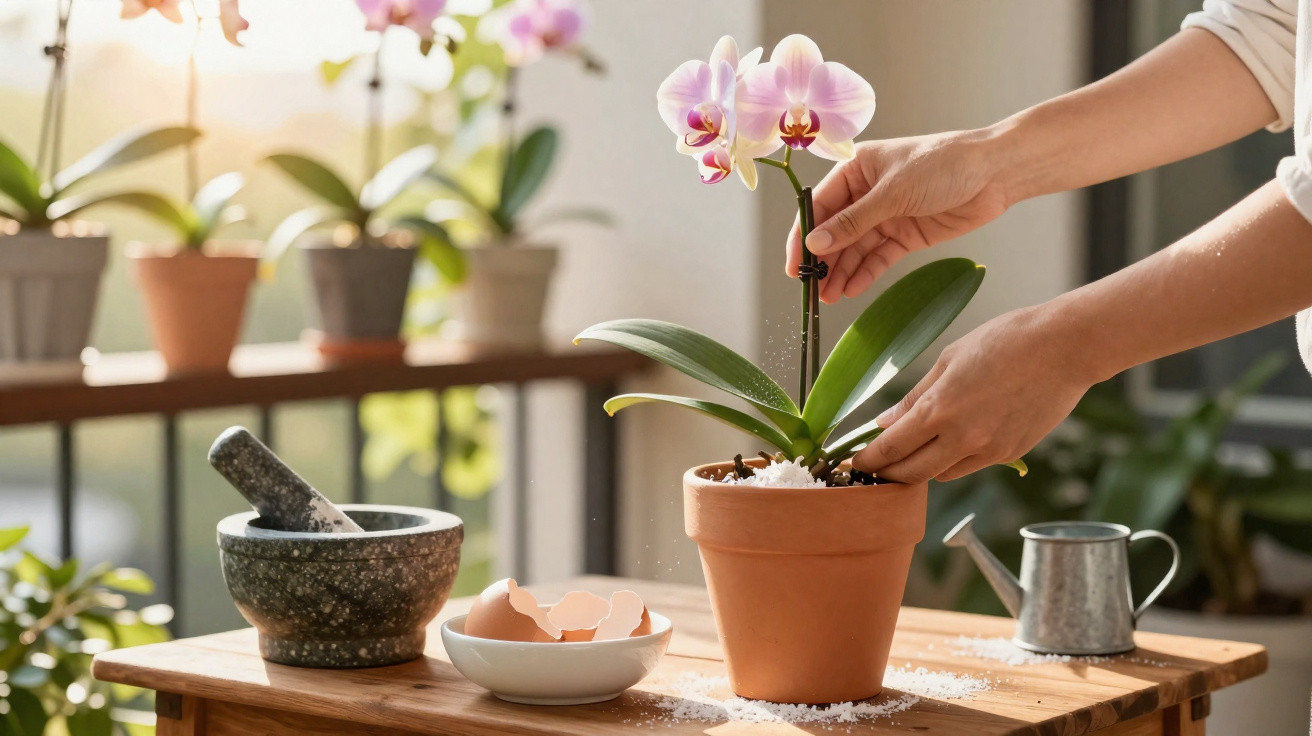
Using eggshells for orchids has become popular among people looking for simple, at-home ways to care for their plants, turning a kitchen leftover into a potential calcium source to support stronger roots and leaves. Even so, there are still plenty of questions about how much this practice truly affects plant health and flowering.
What do eggshells provide for orchids?
Eggshells are made up largely of calcium carbonate, with small amounts of magnesium and other minerals. Calcium contributes to the structure of cell walls, helping to create firmer plant tissues, which over time can support steadier roots and leaves.
In pot culture, calcium matters, but it remains less central than nitrogen, phosphorus and potassium. For that reason, eggshells act only as a mineral top-up: they do not replace orchid fertilisers and, when overused, they may shift the substrate’s chemical balance and disrupt the uptake of other nutrients.
How to use eggshells without harming orchids
How you prepare and apply eggshells largely determines the outcome. Large fragments barely dissolve and mainly behave like a surface dressing. A very fine powder, however, increases contact area with the substrate and releases calcium slowly and gradually-without immediate effects or any sudden boost in flowering.
To minimise the risk of build-up, unpleasant odours and smothering the roots, the material should be cleaned, thoroughly dried and finely crushed, then used sparingly on the surface of the pot. A straightforward step-by-step method helps keep the process consistent:
- Wash the shells well, removing any remaining egg white or yolk.
- Leave them to dry completely in a well-ventilated place.
- Grind until you have a fine powder, using a pestle and mortar or a processor.
- Sprinkle a very thin layer over the substrate, without pressing it down.
- Repeat only after a few weeks, if needed.
When do eggshells actually help orchids?
Eggshells tend to be most useful when the plant is already receiving balanced feeding and is growing in a suitable substrate, but shows mild signs of calcium deficiency-especially where the watering water is very low in mineral salts. In these situations, they serve as a modest reinforcement rather than a miracle fix.
Many common orchid issues are linked to incorrect care and will not be solved by adding more calcium. Below are cases where improving routine care usually makes a far bigger difference than adding eggshell:
- Overwatering: soggy, dark roots call for trimming affected parts and increasing the time between waterings.
- Inappropriate light: deep shade reduces flowering, while harsh direct sun scorches the leaves.
- Degraded substrate: an old, compacted mix reduces aeration and encourages fungal problems.
- Lack of a complete fertiliser: without adequate nitrogen, phosphorus and potassium, the plant grows weakly and flowers less.
Are eggshells for orchids worth it day to day?
In everyday care, eggshells are a low-cost, readily available option that adds small amounts of calcium over the course of months. In well-managed pots-with good airflow, balanced fertiliser application through watering, and suitable light-this habit tends to be a minor extra rather than something that changes how the plant behaves.
It is best to view eggshells as a supporting measure: they can help a little, particularly with very soft water and well-cared-for collections, but they cannot replace a quality substrate, appropriate fertilisers and regular observation. Tweaking light, watering and repotting schedules usually produces far more noticeable results than any single kitchen tip.


Comments
No comments yet. Be the first to comment!
Leave a Comment