
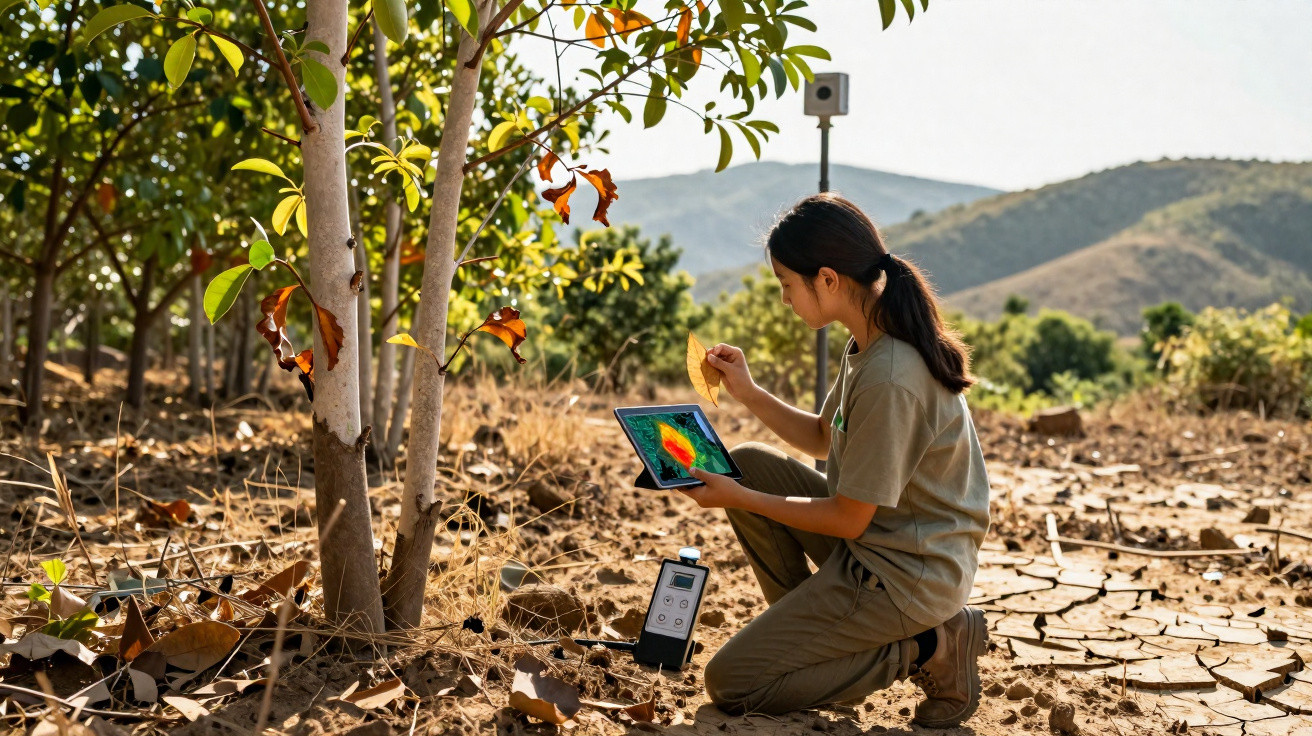
A drooping plant is easy to read as one that needs watering - and most of the time that is true, with roots stuck in soil that has become dry and compacted. That mental image has shaped how drought is understood, and how researchers have tended to quantify it.
Yet plants can sit above moist ground and still dehydrate, because drought can also occur in the air. A new study shows that when the soil and the atmosphere dry out at the same time, the resulting blow to plant growth is much larger than scientists had anticipated.
Two droughts at once
Researchers generally separate the dryness plants face into two categories. The first is a shortage of water in the ground - the soil moisture that roots depend upon.
The second is atmospheric drought: conditions where the air becomes so dry that it pulls water directly from leaves.
Most of the time, these pressures appear on their own. But they can coincide - an overlap that scientists refer to as a compound drought.
A group led by Professor Chiyuan Miao, a hydroclimate scientist at Beijing Normal University (BNU), set out to quantify what this pairing means for plant life across the globe.
Before this work, the relative burden of each drought type was unclear - difficult to compare and even harder to combine into a single picture.
Much of the previous research treated soil dryness and air dryness separately, leaving the joint impact poorly characterised. Miao’s team set out to produce one consistent, global accounting.
The combined toll
When the researchers compared three scenarios side by side, one outcome stood out sharply. One compound-drought event reduced plant growth by nearly four times as much as dry air or dry soil when either occurred alone.
Individually, dry air and dry soil proved to be more alike than expected in their effects, each trimming only a modest amount of growth. Together, however, the damage did not merely sum - it escalated.
That difference is what the field had not previously been able to nail down. Scientists had long suspected that dry air and dry soil intensify one another, but the magnitude had not been quantified.
Another study had already cautioned that the associated carbon loss was being substantially underestimated.
Decades of satellite data
To detect this signal, the team relied on satellite records starting in 1982 and continuing through 2018. These data capture how much carbon plants take up via photosynthesis, season after season.
Using satellites meant the researchers could track vegetation across the entire planet, rather than being limited to a small number of field sites.
Because the record spans decades, they could identify each drought as it developed and ended, and then follow how plants reacted.
They classified each event by drought type and severity, and then linked it to the subsequent drop in growth. Working at a global scale helped local quirks average out, producing a clearer worldwide view.
Forests react differently
Forests did not all respond in the same way. Broad-leaved forests - those with wide, flat leaves - suffered the greatest losses during compound droughts and during dry-air events on their own.
Needle-leaved forests, including pines and spruces, showed a contrasting pattern. They were hit hardest when soils dried out, and they coped much better with moisture-hungry air.
The difference likely lies in leaf form. Broad leaves can lose water rapidly when the air dries, whereas needles retain moisture more effectively and depend more heavily on whatever water roots can still access.
Heat and rainfall drivers
Weather conditions underpinned all three drought types. Temperature and rainfall played the biggest roles in determining when and where dryness occurred, and how sharply plant growth declined.
Losses linked to dry air followed heat closely, since warmer air typically draws more moisture from plants. By contrast, the factors behind soil dryness were more complicated and varied by region.
This link with heat is not an isolated finding. Other research indicates that as the climate warms, the atmosphere’s demand for plant moisture increases further, reinforcing the air-driven losses observed by the team.
Slow to bounce back
The damage did not end when rainfall returned. In more than 60% of the regions analysed, plants took longer to recover after a compound drought than after either drought type on its own.
In many cases, a complete rebound never happened. Numerous areas regained only part of what they had lost before the next spell of stress arrived, leaving an enduring drag across the landscape.
Regions that have experienced both forms of dryness together show this effect plainly.
One analysis of an intense 2023 dry spell in southwestern China linked record declines in plant growth to precisely this kind of combined stress.
What the findings change
The key advance is the scale of the difference. For the first time at global scale, the study puts a number on how strongly dry air and dry soil amplify one another, far beyond the impact of either in isolation.
Each year, the world’s plants remove a substantial share of human carbon emissions from the atmosphere, slowing the pace of planetary warming.
If compound droughts reduce that carbon uptake more than current models assume, projections of future warming could be too low.
This gives researchers a clearer target. Climate models can incorporate the larger cost of overlapping droughts.
It also helps those managing forests and farmland to prepare for a recovery that may be slow - and, without intervention, may never fully return to previous levels.



Comments
No comments yet. Be the first to comment!
Leave a Comment