
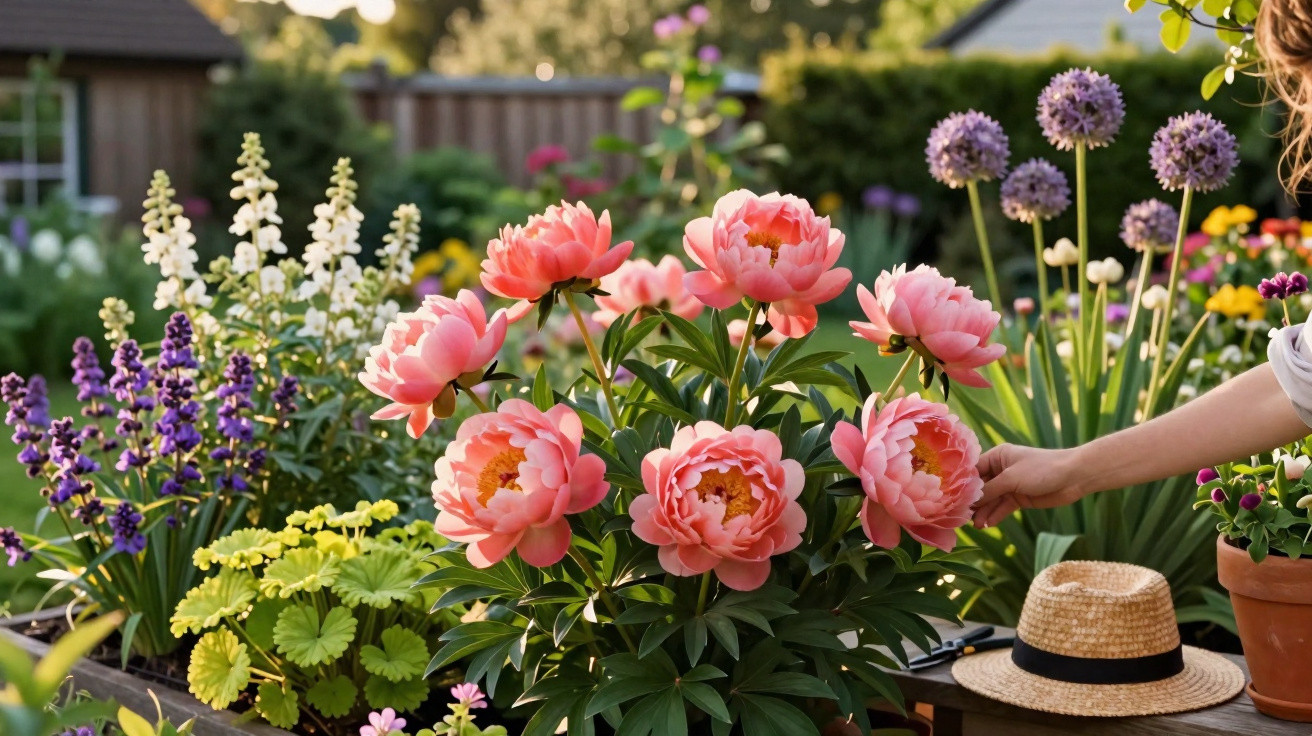
Many garden enthusiasts tuck peonies into a border wherever there’s space, then wonder why the display falls short. Often, the decisive factor isn’t the fertiliser or even the variety, but the plants growing right beside them. Choose the right companions and you’ll get noticeably more from your perennials-both in looks and in overall health.
What peonies really need before you add neighbouring plants
Peonies have a reputation for being easy-going, yet they’re quite specific about the conditions they like. Ignore those preferences and you increase the risk of fungal problems and disappointing flowering. They favour full sun or light partial shade, plus a deep, nutrient-rich soil that still drains freely. Winter waterlogging can severely damage the roots.
Just as crucial: peonies don’t appreciate pushy plants crowding in close. Planting too densely keeps moisture lingering on the foliage, which encourages fungi such as grey mould. Vigorous neighbours with strong root systems can also deprive peonies of water and nutrients.
"If you give peonies air, light and space, you’ll get sturdier plants and more dependable blooms-year after year."
Three straightforward rules make planning any peony bed easier:
- Choose only plants with similar light and soil requirements.
- Don’t place significantly taller species directly in front of the perennials.
- Leave an obvious, airy “breathing space” around each peony.
Alchemilla and more: ground cover that makes peonies glow
Once the position is right, you can focus on the fun part-design. The most successful neighbours are those that visually support the big, lush peony flower heads without smothering them.
Alchemilla: a soft veil instead of competition
Lady’s mantle (Alchemilla) is a classic partner. This tough perennial forms a loose-looking carpet of rounded, gently crinkled leaves. In early summer, airy yellow-green flower sprays hover above the foliage like a fine mist. That light, hazy effect makes pink, white and pastel peonies appear even more vivid-both in the border and as cut flowers.
Lady’s mantle stays fairly low, roots shallowly, and barely competes with peonies for nutrients. At the same time, its foliage covers the soil so the gaps between plants don’t look bare.
Bell-shaped perennials for a lighter look
Perennials with bell-like flowers add movement and an easy, airy feel to a peony planting. Many types of bellflower and similar plants work well because they tend to stay compact and don’t interfere deeply with peony roots.
One detail does need consideration: bellflowers and other delicate species can attract more pests. If you want to include them, plan the planting so there are plenty of “protective plants” nearby-species whose fragrance and essential oils help deter unwanted visitors.
Hydrangeas, irises and daylilies for a ribbon of flowers over months
Peonies only flower for a few weeks-but they do it spectacularly. With thoughtful planning, you can still create a long sequence of interest from spring through to late summer.
Hydrangeas as a calm backdrop
Hydrangeas make excellent background plants. Their dense shrubs and large, rounded flower heads echo the peonies’ full shapes. Positioned a little way behind, they can cast light shade on hot summer days without blocking the peonies entirely.
The soil can be humus-rich and fertile, as long as excess water can drain away. Hydrangeas cope with sun provided there’s enough moisture, and they can be planted from autumn through to spring depending on your region and the weather.
Irises and daylilies: passing the flowering baton
A staggered flowering schedule is especially appealing:
- Bearded irises open just before peonies, bridging the colour shift from spring to early summer.
- Peonies then take centre stage with their large, often fragrant blooms.
- Daylilies carry on through summer when peonies are showing more foliage than flowers.
That way, the border stays visually filled rather than dropping into a lull. Choose varieties in similar shades for a calm, refined look, or lean into contrast-such as violet irises alongside soft pink peonies.
Lavender as scented protection: attractive and practical
Lavender pairs surprisingly well with peonies, provided the soil isn’t heavy and wet. Both prefer sun and free-draining ground. As a subshrub, lavender forms dense lines that are ideal along the front edge of a bed.
"Lavender doesn’t only add colour and scent-it acts like a living protective wall against many garden pests."
Its strong fragrance puts off a range of insects and even larger visitors. Mosquitoes, flies, some sap-sucking pests, and often deer too tend to avoid the smell. Plant lavender along the border edge and you create a naturally perfumed barrier, allowing peonies to develop with less pressure.
Allium species play a similar double role. Their spherical flower heads are decorative, while their sulphur-like scent discourages various insects. Planted among peonies, they also add vertical structure and a little extra protection.
Which plants do not belong in a peony bed
Mixed borders can be beautiful, but not every fashionable plant is a good neighbour. A common mistake is using very vigorous ornamental grasses that spread with dense root balls. They draw heavily on water and nutrients and reduce airflow around the peonies.
Plants that prefer permanently wet, heavy soils are also a poor fit. They encourage exactly the long-lasting damp conditions in which fungal diseases can take hold on peonies. The result can be limp stems, rotting buds and brown spots on the leaves.
| Suitable neighbours | Unsuitable neighbours |
|---|---|
| Lady’s mantle (Alchemilla) | Large, strongly spreading ornamental grasses |
| Bellflowers and other bell-shaped perennials | Plants for permanently wet, boggy soils |
| Hydrangeas in the background | Shallow-rooted, heavy-feeding shrubs planted right against the clump |
| Irises, daylilies, alliums | Dense ground cover that creeps right up to the stems |
| Lavender as edging | Any species that increases humidity in the bed |
Practical examples: what a successful peony bed looks like
If you’re starting out with peonies, simple combinations are a reliable guide. One option: place two or three peony clumps in the centre, slightly offset. In front, run a loose band of lady’s mantle with a few allium globes dotted through it. Add a small hydrangea shrub at the back, and finish with a strip of lavender along the edge.
Another layout leans more strongly on successive flowering: a row of bearded irises, peonies behind them, alliums threaded between, and hydrangeas at the far end of the bed. In the foreground, include daylilies that flower later. This creates a bed that stays colourful from May into August.
What hobby gardeners should also keep in mind
Newly planted peonies reward patience. They often take two to three years to show their full potential. During that establishment period, it’s worth keeping planting especially open so they can root in without stress. Later on you can fill in more densely-always keeping airflow in mind.
It also helps to plant with the future in view: consider the space a peony will need in five to ten years. Older clumps can become impressively large. If you plan too tightly, you may end up with an overcrowded bed a few years later, where fungal diseases spread more easily.
One more factor is frequently underestimated: soil preparation. Deeply loosened ground, improved with compost but never waterlogged, is invaluable for peonies. In heavy soils, drainage-such as adding gravel-significantly reduces the risk of root rot. Put in that effort at the start and you can enjoy healthy, floriferous perennials for many years.





Comments
No comments yet. Be the first to comment!
Leave a Comment