
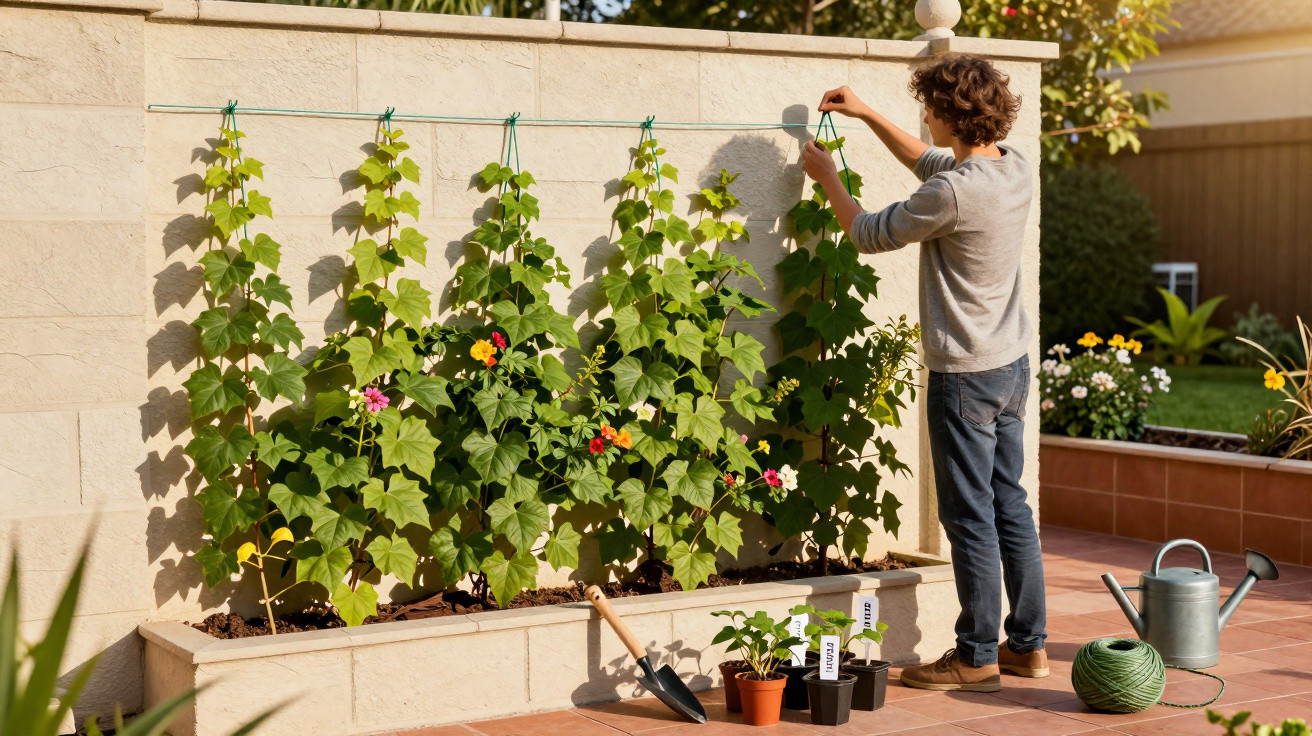
Among the many plant choices for urban gardens, climbing plants stand out because they take up very little ground space while turning plain boundary walls into living green panels. If you want fast coverage without building work or complicated supports, a few species are particularly valued for their performance, easy upkeep and a lower likelihood of harming plaster, paintwork or the wall itself.
How do you choose ideal climbing plants to cover walls?
When planning a green wall, it is important to pick climbers with moderate root systems that suit the space available. Not every fast-growing plant is a good match for growing directly against masonry, especially where walls have been plastered and painted.
Some climbers do best when trained along wires or a simple trellis, while others attach themselves to the surface using their stems. That difference affects the finished look, the ongoing maintenance and how well the wall holds up over the years.
Watch a video on the YouTube channel Cada Caule showing 10 climbing plant species for walls and pergolas:
What are the best climbing plants for residential walls?
In home gardens, popular options include a less-aggressive ornamental cat’s claw vine, ivy in more controlled cultivars, a small-growing climbing frangipani jasmine, star jasmine and blue thunbergia. With suitable light, watering and feeding, all of them can provide rapid coverage.
To achieve a lush, attractive green finish, it can be worth mixing flowering climbers with plants that have denser foliage. That way, the wall can deliver striking flowering periods while still keeping a consistent green backdrop throughout the year.
Which climbing plants have less aggressive roots for masonry walls?
With masonry walls, many people worry about cracks, damp ingress or paint failure. That risk is reduced when you choose climbers with shallow, well-contained roots, grown in defined planting beds and watered in a controlled way so they do not push outwards in search of moisture.
Among the species most often used successfully on walls-and which are typically considered “plaster-friendly” when properly cared for-are:
- Star jasmine (Trachelospermum jasminoides): fine roots and moderate-to-fast growth; needs tying in at the beginning and rarely damages plaster.
- Blue thunbergia (Thunbergia grandiflora, in compact cultivars): vigorous, but with roots that are not usually aggressive when planted in a well-bounded bed.
- Dipladenia or mandevilla: relatively contained roots, showy flowers and excellent performance on sunny walls.
- Compact ivy: some varieties cling more firmly, but more delicate cultivars, kept in check with regular pruning, tend to be less destructive.
How do you plant, train and maintain climbing plants on walls?
Before planting, the wall should be sound, with no visible damp and no hollow or loose sections. The soil at the base needs improving with organic matter and good drainage. Dig planting holes around 30 to 40 cm deep and position them slightly away from the wall’s base, encouraging the roots to develop in the soil rather than in the masonry.
After planting, early training using wires, lightweight trellis and soft ties is what shapes the final coverage pattern. Over time, light pruning for tidiness and control, feeding in late winter and early spring, and watering adjusted to local conditions keep the green screen dense, make future repainting easier and extend the lifespan of both the plant and the wall structure.
Comments
No comments yet. Be the first to comment!
Leave a Comment